


Last Updated: October 30, 2026
Quick Summary
Art does not reliably art increase home resale value, because it does not change a home's appraised value or sale price. Art is staging, not structure: it shapes how buyers feel in a room, but it is personal property that generally leaves with you at closing.
- Fix condition first with paint, light, hardware and floors, then style the space with art.
- Wall decor is personal property, not part of the structure an appraiser values.
- Hang art with its center at eye level, roughly 57 to 60 inches from the floor.
- Make art width about two-thirds the width of the furniture below it.
- Photograph and note in the listing agreement every piece you plan to take with you.
Table of Contents
- Does Art Increase Home Resale Value? The Honest Answer
- What Buyers Actually Notice: Art, Paint, and First Impressions
- Original Art vs Prints: Which One Belongs in a Home You Plan to Sell
- Giclée Prints Explained: Affordable Impact for Staged Rooms
- Hand-Embellished Prints: The Middle Ground Between Print and Painting
- How to Hang Art at Home So It Reads as Value, Not Clutter
- Appraisals, Ownership, and What Leaves With You When You Sell
- Choosing Art You'll Love Whether You Stay or Sell
- Frequently Asked Questions
Does Art Increase Home Resale Value? The Honest Answer
Does art increase home resale value? Not reliably, it does not change a home's appraised value or sale price. It can, however, shape how buyers feel in a room, and that feeling affects how they judge the whole house. That is the honest version, and it is the version most sellers never hear.
Here is the distinction that matters. Paint changes a surface the buyer keeps. Art changes a mood the buyer feels. One is a permanent upgrade. The other is staging, and staging works only while it is in the room. We would rather you understand that split than buy a painting expecting a return at closing.
Below, we break down what actually moves a sale price, where art fits, and how to choose pieces you will love whether you stay for twenty years or list next spring.
What Buyers Actually Notice: Art, Paint, and First Impressions
Buyers form a first impression fast, and they form it from condition and light before they notice a single object on the wall. A scuffed hallway reads as neglect. A bright, well-kept room reads as cared for. That is why fresh paint shows up in so much selling advice: it is a cost-effective upgrade to interior surfaces, and it photographs well.
Art plays a different role. A well-placed piece gives the eye somewhere to land. It makes an empty room feel finished and a dated room feel current.
Watch out: too much art on every wall does the opposite. It reads as clutter, and clutter reads as small.
So the order of operations is simple:
- Fix condition first: paint, light, hardware, floors
- Then style the space with art and decor
- Keep the palette calm so buyers project themselves into the room
Paint is the renovation. Art is the finishing layer.
Original Art vs Prints: Which One Belongs in a Home You Plan to Sell
Original art and prints do different jobs in a home you may sell, and the difference is not just price. An original is a one-of-a-kind piece you keep, insure, and take with you. A print is a reproduction, often a giclée or a limited edition, that finishes a room at a lower commitment. Neither adds to the appraisal, because wall decor is personal property, not part of the structure being valued.
That said, the two behave differently on a showing day. A strong original gives a room a focal point buyers remember, because the eye lands on real brushwork and texture. A print can do the same visual work at a fraction of the cost, which matters when you are styling a house you are about to leave and want to protect your budget.
Here is the trade-off in plain terms:
- Original art, one of a kind, carries the artist's hand, holds meaning for the owner, and travels with you at closing. Best for the home you plan to keep and collect in.
- Limited edition prints, numbered, signed, produced in a fixed run, and more affordable than an original. Good for finishing a room you will show and then take with you.
- Open edition prints, unlimited reproductions, the least expensive option, and the least distinctive on a wall. Fine for temporary staging, weaker as a long-term purchase.
A common pattern among sellers is to keep originals in the rooms they live in and use prints in the rooms they are preparing to show. That way the art you love stays protected, and the staging layer stays flexible.
If you are weighing the two, our comparison of buying original art online versus prints walks through the trade-offs, and our breakdown of original art versus canvas prints covers how canvas reads on a wall.
The three main options behave differently on a wall and in a sale, so here is the trade-off in plain terms.
| Option | What it is | Best for |
|---|---|---|
| Original art | One of a kind, carries the artist's hand, travels with you | The home you plan to keep and collect in |
| Limited edition prints | Numbered, signed, produced in a fixed run, more affordable | Finishing a room you will show and then take with you |
| Open edition prints | Unlimited reproductions, least expensive, least distinctive | Temporary staging, weaker as a long-term purchase |
Giclée Prints Explained: Affordable Impact for Staged Rooms
A giclée print is a high-resolution reproduction made with pigment-based inks, designed to hold its color and detail longer than a standard poster print. That definition matters when you are staging: you want color that reads true in photos and on a showing day.
Giclée prints give you big impact for less money than an original. They also let you scale a piece to a large wall without the cost of a large painting. For sellers, that means you can style a living room properly and still take the art with you.
If you want a fuller explainer before you decide, read our guide to contemporary prints and how they are made.
Hand-Embellished Prints: The Middle Ground Between Print and Painting
A hand-embellished print is a print the artist has painted over by hand, so each piece carries real brushwork and slight variation. It sits between a reproduction and an original. You get texture and individuality without the price of a fully original painting.
Why does this matter for a seller or a stayer? Texture photographs well, and texture reads as quality to a buyer walking through. A flat print can look like decor. A hand-embellished piece looks like art.
It also solves a common worry: buyers want something authentic, not mass-produced. Hand-embellished prints are finished by hand, so each piece carries individual variation.
How to Hang Art at Home So It Reads as Value, Not Clutter
Hang art so the center of the piece sits at eye level, roughly 57 to 60 inches from the floor, and let the furniture below it anchor the wall. That one rule fixes most bad hangs. Then scale the art to the wall: a small piece floating on a large empty wall reads as an afterthought, while an oversized piece in a tight hallway feels cramped.
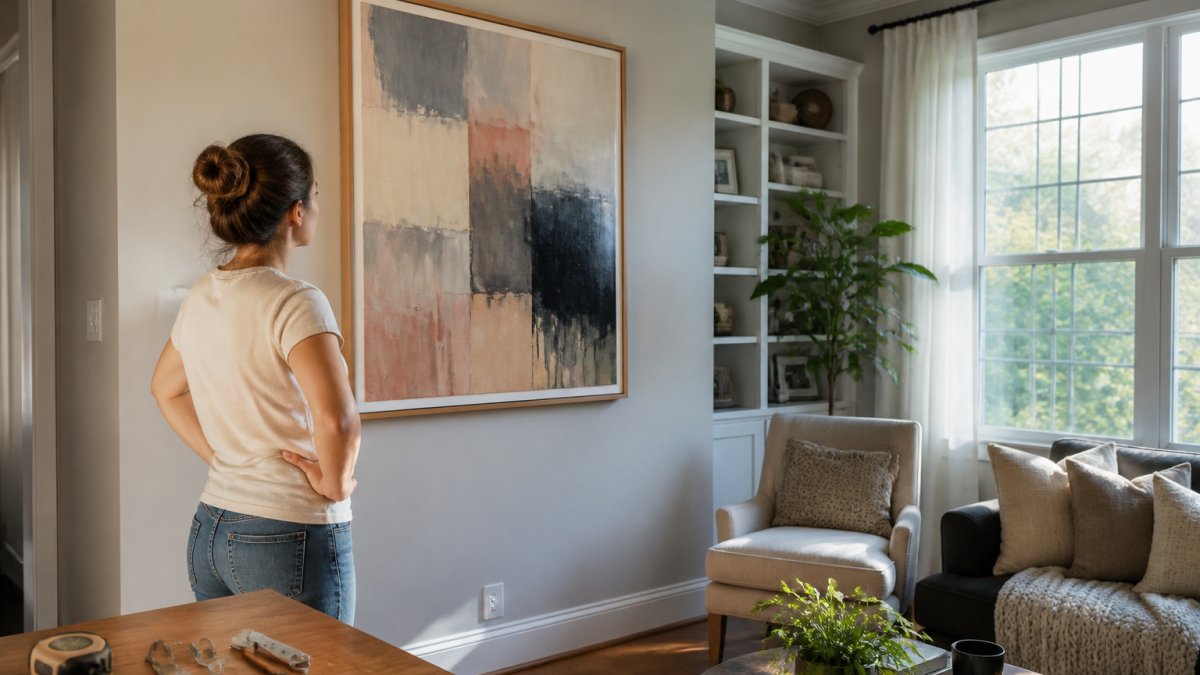
A short checklist before you commit to a nail:
- Center of the art at eye level, 57 to 60 inches up
- Art width about two-thirds the width of the furniture below
- One strong focal wall, not five competing ones
- Consistent spacing between grouped frames
- Skip the tiny piece on the giant wall
If your rooms are tight, our guide to styling art in small apartments covers scale and placement in less space.
Appraisals, Ownership, and What Leaves With You When You Sell
Art typically does not enter a home appraisal, because appraisers value the property, not the contents. Your paintings are personal property, and personal property is generally excluded from the home's valuation.
That has a practical consequence. Unless a piece is built into the house, a mural, a commissioned wall treatment, a custom built-in, it leaves with you. The line between personal property and a fixture is the line that decides what stays. A framed painting hung on a hook is almost always personal property.
So decide early what stays and what goes, and put it in the listing agreement if a buyer assumes a piece is included. Document the items you are excluding, photograph them in place, and label them clearly for showings.
One more note on evidence: claims that art boosts resale by a set percentage are usually borrowed from paint and renovation studies, not art. Treat those numbers with skepticism. The Appraisal Institute's guidance on what appraisers evaluate focuses on the property itself, and the Consumer Financial Protection Bureau's guide to appraisals explains how a home valuation is conducted.
Choosing Art You'll Love Whether You Stay or Sell
Choose art you would keep if you never sold, then treat it as a bonus that it helps the room show well. That is the throughline here: art is a personal and emotional purchase first, and a staging tool second. Buy for the wall you live with every day.
A few rules we would give a friend:
- Buy the piece you keep circling back to
- Favor strong composition over a trend palette
- Mix originals and prints rather than filling every wall with one type
- Frame properly, since a good frame changes how a piece reads
A common mistake is buying art to match a couch. Couches get replaced. Good art outlasts them. If cost is the sticking point on an original, our piece on whether original painterly art is worth the cost addresses that head-on.
Selling a home is stressful, and the art on your walls should not add to it. At Annette Back Fine Art, we help you choose pieces that brighten a room and hold their meaning long after the listing goes live. Our collection pairs original paintings with limited edition prints, professional framing is arranged by the artist, and virtual live viewing and consultation services are available. Get started with Annette Back Fine Art and find art that earns its place on your wall, whether you stay or sell.
Frequently Asked Questions
Does original art add value to a home?
Original art can add perceived value by making rooms feel finished and memorable, but it rarely appears as a line item in an appraisal. Appraisers typically value the property, not the contents, so a painting you take with you when you move does not raise the sale price. Where art helps is buyer perception: a well-placed original gives a room a focal point and signals care. Treat it as a staging and enjoyment decision first, and a financial one second.
Are original paintings more valuable than prints?
In the art market, yes. An original painting is a one-of-a-kind work, while a print is one of an edition, so originals generally hold more resale potential as collectibles. For home resale, though, the difference matters less than fit. A giclée print or hand-embellished print can deliver the same visual lift in a staged room at a lower commitment. Buy originals because you want the piece, not because you expect it to boost a house price.
What is a hand-embellished print?
A hand-embellished print starts as a high-quality reproduction, often a giclée, and the artist then adds paint, texture, or detail by hand. Each piece ends up slightly different, so it carries more of the artist's touch than a standard edition while costing less than a full original. For homeowners who want texture and individuality on a wall without commissioning a painting, it sits in a practical middle ground.
How should you hang art at home before a showing?
Center the artwork at eye level, roughly 57 to 60 inches from the floor to the middle of the piece, and keep it close to the furniture it relates to, such as above a sofa or console. Use one strong statement piece per room rather than many small frames, and remove personal photos and anything overly specific. The goal is a calm, finished room where buyers notice the space, not a gallery wall that feels crowded.


0 comments