


Table of Contents
- Original Art vs Prints: A Side-by-Side Comparison
- Price Points: What You Actually Pay For
- Fine Art Photography Prints and Archival Quality
- Hand Embellished Prints: Texture Without the Original Price
- How to Display Original Art and Prints in Your Home
- Commissioning Custom Artwork: When Nothing Off the Rack Fits
- Investment, Resale, and Provenance: The Long Game
- Frequently Asked Questions
Last Updated: October 2, 2026
Original Art vs Prints: A Side-by-Side Comparison
Choosing between buying original art online vs prints comes down to one question: do you want the only one, or a faithful reproduction of it? An original artwork is a one-of-a-kind piece made by the artist's hand, while a print is a reproduction of that work, produced either as an open edition or a numbered limited edition. This guide from Annette Back Fine Art breaks down what each option actually delivers.
The distinction matters more than most buyers expect. An original carries brushstrokes, texture, and a physical presence no reproduction can copy. A print carries accessibility, consistent sizing, and a lower entry point. Neither is the "right" answer.
Here's the part most guides skip: the price gap between originals and prints is not the whole story. Framing, glazing, and UV protection can add real cost to either path, and those numbers rarely appear until checkout. Below, we compare both options across price, archival quality, texture, display, and resale so you can decide with your eyes open.
| Factor | Original Artwork | Print (Open or Limited Edition) |
|---|---|---|
| Uniqueness | One-of-a-kind | Reproduction, edition size varies |
| Entry cost | Highest | Lower to moderate |
| Texture | Visible brushwork, impasto | Flat, unless hand embellished |
| Archival life | Decades with proper care | Depends on inks and paper stock |
| Resale | Secondary market, provenance-driven | Limited, mostly decorative value |
| Best for | Collectors, statement walls | First-time buyers, flexible spaces |
Price Points: What You Actually Pay For
Price reflects labor, materials, and scarcity, not just size. An original painting represents hours of the artist's time plus canvas, paint, and a single sale. A print spreads that same image across many buyers, which is why reproductions cost less.
At Annette Back Fine Art, that range is visible in the catalog itself. The Fire & Rose - Gallery Wrap is a canvas reproduction at $40.00, while the Fire & Rose - Framed Print runs $200.00 in its framed format. A matte Deux-Pair - Photo Print sits at $120.00. Hand embellished limited editions climb higher: Happy, a signed and numbered 1/25 canvas, is $220.00, and the four-panel Branches set is $399.00.

What most buyers miss is the hidden cost on top. Framing and glazing frequently add more than the artwork itself, and shipping for a large canvas is not the same as shipping a rolled print. Budget for the total wall, not the piece alone.
Fine Art Photography Prints and Archival Quality
Archival quality is the difference between a print that lasts decades and one that fades in a few summers. Fine art photography prints and giclee reproductions use pigment-based inks rather than dye-based inks, printed onto acid-free paper stock or premium canvas. Pigment inks resist UV degradation far better than dye inks, which is why galleries specify them.
The paper or canvas matters just as much. A heavyweight matte paper holds detail without glare; a canvas accepts a protective coating and can be stretched. Annette Back Fine Art prints its reproductions onto premium canvases and photo papers, then finishes them for hanging.
Ask any seller three questions before buying: which ink type, which substrate, and whether the print is signed.
Hand Embellished Prints: Texture Without the Original Price
Hand embellished prints sit between the two extremes, and they solve the texture problem. A hand embellished print is a reproduction that the artist paints over after printing, adding brushstrokes, highlights, or metallic accents directly onto the canvas. The result is a piece with real visual depth and physical presence, produced in a controlled edition.
The Branches set shows how far this can go. Annette Back arranged the same branch lines across four canvases, then developed each panel independently in different color combinations, always using silver as the secondary and highlight color. The four pieces started identically and ended as distinct compositions. That is a print run behaving like a series of originals.
The Happy canvas follows the same logic at a smaller scale: a 16 x 20 hand embellished gallery wrap, limited to 25, signed and numbered. Buyers who want brushwork on a budget should start here rather than with an open edition, because the embellishment is what separates a print from a poster.

How to Display Original Art and Prints in Your Home
Display decisions change how a piece reads, regardless of what you paid for it. The goal when mixing originals and prints is cohesion: the eye should move across the wall without registering which pieces are one-of-a-kind and which are reproductions. That happens through scale, spacing, and framing, not through the artwork itself.
Start with the fundamentals. Hang art at eye level, roughly 57 to 60 inches from the floor to the center of the piece, and keep the top and bottom of a grouping aligned. In a seating area, the bottom edge should sit 8 to 10 inches above the sofa back. Those rules hold whether you are hanging one canvas or twelve.
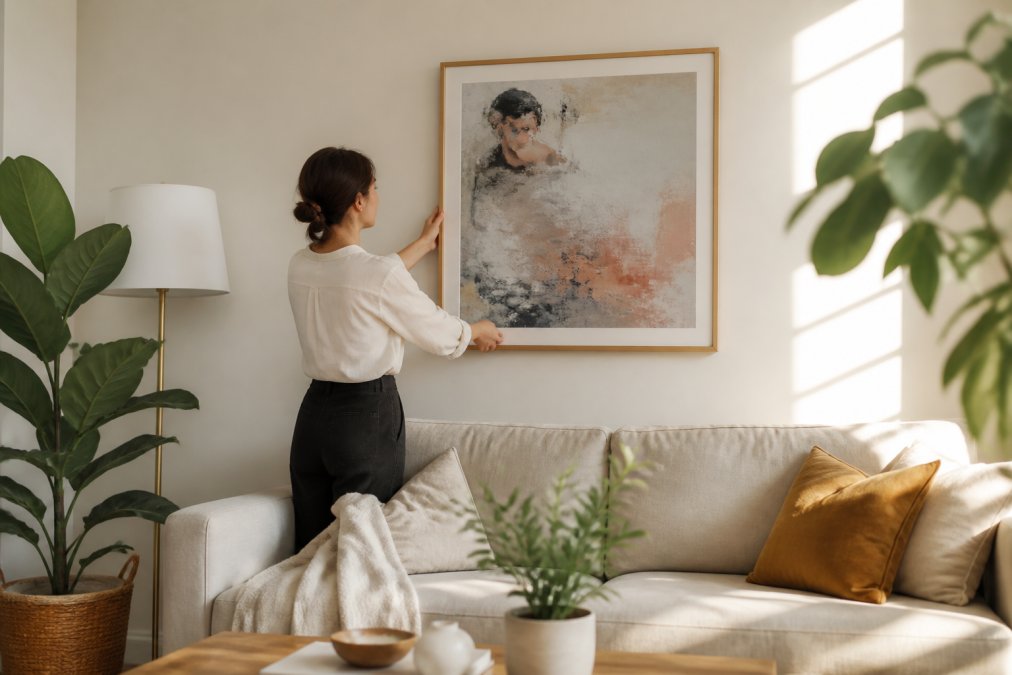
Mixing originals and prints on one wall. A common pattern is to let the original anchor the composition and let prints support it. Place the largest, most visually dense piece, usually the original, slightly off-center rather than dead center, then build outward with smaller prints. Keep a consistent gap between frames, typically 2 to 3 inches, and treat that gap as the rhythm of the wall. If the gaps vary, the wall looks accidental even when every piece is good.
Scaling to the wall, not the furniture. A frequent mistake is sizing art to the sofa instead of the wall. As a rule of thumb, art should cover roughly two-thirds to three-quarters of the width of the furniture below it. On a large blank wall, a single small print will look lost no matter how well it is framed. This is where a multi-panel set earns its place: the Branches set of four 8 x 8 canvases can hang in a row, a grid, or split across two walls, which lets you fill a wide space without hunting for one oversized piece.
Framing for cohesion. Framing is the fastest way to make an original and a print read as a set. Matching frame profiles and mat widths across pieces does more for cohesion than matching subject matter. A canvas wrap needs no glass and can hang bare; a paper print usually benefits from a mat and glazing. If you mix the two, keep the outer frame dimension consistent so the wall reads as one composition.
Light and care. Direct sunlight fades pigment over time, so place works away from south-facing windows or add UV protection in the glazing.
Commissioning Custom Artwork: When Nothing Off the Rack Fits
Commissioning custom artwork is the answer when a wall, a palette, or a story has no match in an existing catalog. The process starts with a conversation about dimensions, color direction, and subject, then moves to sketches or a color study before the artist begins the final piece. Expect weeks, not days.
Investment, Resale, and Provenance: The Long Game
Resale value favors originals, but only when provenance is clean. Provenance is the documented history of a piece: who made it, when, and how it changed hands. A signed original with a certificate of authenticity and a gallery or exhibition record is traceable. That record is what a secondary market buyer pays for, not the paint itself.
Frequently Asked Questions
What is the difference between an original artwork and a fine art print?
An original artwork is a one-of-a-kind piece made by the artist's hand, such as an oil painting. A fine art print is a reproduction of that original, created with pigment-based inks on canvas or paper stock. Prints can be unlimited or limited edition, and some are hand embellished with added brushstrokes. The original carries physical texture and provenance; the print offers the same image at a lower price point.
How does the value of original art compare to limited edition prints?
Original artwork holds the strongest investment potential because it is one-of-a-kind and carries provenance tied directly to the artist. Limited edition prints, especially signed and numbered runs, can also appreciate if the artist's career grows, but the ceiling is lower because multiple copies exist. Hand embellished prints sit between the two, offering texture and a smaller edition size than an open reproduction.
What are hand embellished prints and how do they differ from standard prints?
Hand embellished prints are reproductions that the artist paints over after printing, adding brushstrokes, texture, or color accents to the surface. This makes each piece in the edition slightly different, even when the underlying image is identical. Standard prints come off the press unchanged. Hand embellishment adds visual depth and a tactile quality that flat reproductions lack.
How should I decide between an original piece and a print for my home decor?
Start with budget and wall space. Prints and hand embellished editions work well for scaling art across a room or trying a new style without a large commitment. Originals suit a focal wall where you want a one-of-a-kind presence. Consider framing and glazing costs too, since UV protection matters for both. Buying directly from an artist's online collection often includes consultation to help match scale and palette.
What are the benefits of buying art directly from an artist's online collection?
Buying direct gives you access to the artist's full body of work, certificate of authenticity, and often a live virtual viewing before purchase. You can ask about medium, framing, and shipping in one conversation. Direct purchases also support commissioning custom artwork, where the artist builds a piece around your space and color palette rather than selling you something already finished.


0 comments