


Last Updated: November 17, 2026
Quick Summary
The original painting cost online is driven mainly by size, medium, and the artist's studio hours, with our own pieces ranging from $2,000 for a medium horizontal to $12,240 for a large-format horizontal. The listed price is not the full total, since shipping, framing, and sales tax can add to checkout. Sets cost more than single canvases of similar size because each panel is painted separately.
- Small canvases under roughly 16 x 20 in are the entry point for a first original painting.
- Divide a set price by its panel count before comparing it to a single canvas.
- Ask whether shipping is included or quoted separately before you commit.
- Request the full checkout total in writing, including shipping, framing, tax, and fees.
- Ask for a certificate of authenticity, provenance, and listing details that match.
Table of Contents
- What Drives the Original Painting Cost Online
- Price Ranges by Painting Size and Format
- Original Art for Sale Online: What You Actually Pay
- Giclée Art Prints and Where They Fit in a Budget
- Limited-Edition Art Prints and Hand-Embellished Prints Explained
- The Costs That Show Up at Checkout
- Choosing the Piece That Fits Your Home and Budget
- Frequently Asked Questions
What Drives the Original Painting Cost Online
The original painting cost online starts with three things: size, medium, and the hours an artist spends at the easel. At Annette Back Fine Art, we price each piece against those realities rather than against a marketplace algorithm, because a painting is not a product that rolls off a line.
A small study on canvas and a large-format artwork demand different materials, different drying time, and different studio space. Oil painting also carries a longer working cycle than acrylic painting, since layers need time to set before the next pass. That labor is invisible in a photograph but very real in the price.
Size, Medium, and the Hours Behind the Canvas
Painting dimensions drive cost more than any other single factor. A compact painting uses less canvas, less paint, and fewer sessions. A large painting can take weeks of layering, drying, and reworking before the artist signs it.
Medium matters too. Oil painting rewards patience and allows depth that acrylic sometimes cannot match, and that patience is billed in hours. When you compare prices, compare the canvas size and the medium first, then the name.
How Artist Reputation Changes the Asking Price
Artist reputation moves the asking price as much as size does. An emerging artist may price a study modestly to build a collector base. An established artist with exhibition history and a documented body of work can ask considerably more for a comparable canvas.
Sales history is the quiet signal here. A painter whose work has sold consistently, and whose pieces hang in private collections, has a market value that new listings cannot claim. If you want to dig into whether higher prices for painterly originals hold up, read our breakdown of the value of original art.
Price Ranges by Painting Size and Format
Size sets the floor and ceiling of an original painting cost more reliably than any other variable.
A useful way to read any listing is to sort it into one of three size bands before you look at the number:
- Small (roughly under 16 x 20 in): studies, single-subject pieces, and small square canvases. These are the entry point for a first original and the easiest to place on a narrow wall or in a hallway.
- Medium (roughly 20 x 30 in to 30 x 40 in): the workhorse band for living rooms and dining walls. Most buyers who want a statement without a large-format commitment land here.
- Large (roughly over 30 x 40 in, or any multi-panel set): large-format horizontals, tall verticals, and sets. These carry the most studio hours and the highest shipping and crating costs, which is why the landed price climbs faster than the canvas size suggests.
Here is how our own collection breaks down, so you can see the pattern in real numbers rather than a generic estimate.
| Piece | Dimensions | Format | Size band | Price |
|---|---|---|---|---|
| Branches (set of 4) | 12 x 12 in each | Small square set | Small (set) | $2,790 |
| Shma | 32 x 20 in | Medium horizontal | Medium | $2,000 |
| I Am Woman (set of 3) | 12 x 30 in each | Tall set of three | Medium (set) | $3,300 |
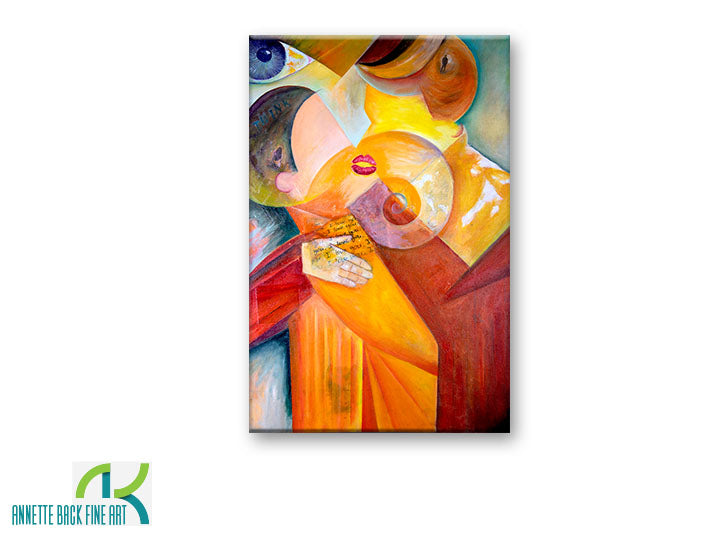
| Kiss Me | 24 x 36 in | Large vertical | Large | $10,800 |
| In Dreams | 40 x 16 in | Large-format horizontal | Large | $12,240 |
Price
Notice that sets complicate the math. Four small canvases priced together, or three tall panels sold as one work, carry more labor than a single canvas of the same total area, each panel is stretched, primed, painted, and finished separately.
Watch out: comparing a set price to a single-canvas price without dividing by the number of panels is the most common way buyers misjudge value.
If you want to see how these size bands translate into a specific piece, Kiss Me by Annette Back, 24 x 36 sits in the large vertical band at $10,800, while Shma shows what the medium horizontal band looks like at $2,000.
Original Art for Sale Online: What You Actually Pay
The figure on the listing is not the figure you pay. Original art for sale online carries a total checkout cost that includes shipping, any framing you add, and sales tax where it applies. A painting that looks affordable at the listed price can climb once those line items land.
Ask two questions before you commit. First, is shipping included or quoted separately? Second, does the piece arrive ready to hang, or does it need a frame? If you are weighing an original against a reproduction, our guide to buying original art online versus prints walks through the trade-offs side by side.
Giclée Art Prints and Where They Fit in a Budget
Giclée art prints are high-resolution reproductions printed on fine art paper or canvas, and they exist to bring a composition you love into your home at a fraction of the original painting cost. The printing quality can be excellent. What you give up is the one-of-a-kind status, the texture of real brushwork, and the resale value an original holds.
For a first purchase, or for a room where you want a specific color story without committing to a large sum, a giclée is a sensible entry point. If you are deciding between a print and a canvas reproduction, our comparison of original art versus canvas prints covers how each holds up over time.
Limited-Edition Art Prints and Hand-Embellished Prints Explained
Limited-edition art prints are released in a fixed number, each one numbered and signed, which gives the buyer a defined scarcity that open-edition prints never offer. The edition size is stated up front, and once it sells out, that run is closed.
Hand-embellished prints sit between a reproduction and an original. The artist prints the base image, then adds paint by hand to each piece, so no two are identical.
What Makes Hand-Embellished Prints Different
The hand work is the whole point. Brushstrokes added over the printed surface give each hand-embellished print its own texture and small variations, which means you are buying something with genuine artistic touch rather than a flat copy.
Expect to pay more than a standard limited-edition art print and less than an original canvas. For a deeper look at how these categories differ, our overview of contemporary print types explains the distinctions clearly.
The Costs That Show Up at Checkout
The figure on the listing is not the figure you pay. Original art for sale online carries a total landed cost that includes shipping, any framing you add, sales tax where it applies, and, for buyers outside the seller's state, the possibility of use tax owed on the purchase.
The Four Line Items That Change the Total
Shipping and crating. Fine art needs rigid packaging, corner protection, and often a wooden crate for large-format artwork. That cost scales with size, weight, and distance, and it is frequently quoted separately from the artwork price.
Framing. A gallery-wrapped canvas with finished sides needs nothing and can hang as-is.
Sales tax. Whether tax is added at checkout depends on where you live and how the seller is registered. Some sellers collect it; others do not, which can leave you responsible for use tax on your own return.
Payment and handling fees. Some checkout systems pass along card processing or handling fees. These are usually small, but they belong in the total you compare against other listings.
How to Verify You Are Buying an Original
Price is only half the decision. The other half is confirming that the painting is what the listing says it is. Ask for three things before you pay:
- A certificate of authenticity signed by the artist, stating the title, medium, dimensions, and year.
- Provenance, the ownership history of the piece, which for a living artist usually means the artist's own records and any prior gallery or exhibition documentation.
- Listing details that match, the medium, dimensions, and signature should be consistent across the listing, the certificate, and the artist's own catalog.
A common pattern is that established artists and galleries supply a certificate as a matter of course, while marketplace resellers sometimes do not. If a seller cannot or will not provide one, treat that as a reason to slow down.
Returns and Buyer Protections
Return policies for original art vary widely. Some sellers accept returns within a stated window if the piece is undamaged and in its original packaging; others treat original sales as final. Ask two questions before you commit: what is the return window, and who pays return shipping on a large crated piece?
Watch out: assuming the listed price is your final number is the most common budgeting mistake we see. Request the full checkout total, artwork, shipping, framing, tax, and any fees, in writing, and confirm the return terms at the same time.
If you are weighing an original against a reproduction, our guide to buying original art online versus prints walks through the trade-offs side by side.
Choosing the Piece That Fits Your Home and Budget
Start with the wall, not the price tag. Measure the height and width of the space, then match the painting dimensions to it.
Next, decide what you are buying. An original artwork is a one-time purchase that holds artistic value and can appreciate with the artist's career. A print is decor you can rotate freely.
If you are ready for an original, Kiss Me by Annette Back, 24 x 36 is a large vertical oil on gallery-style canvas, signed and dated by the artist, priced at $10,800.
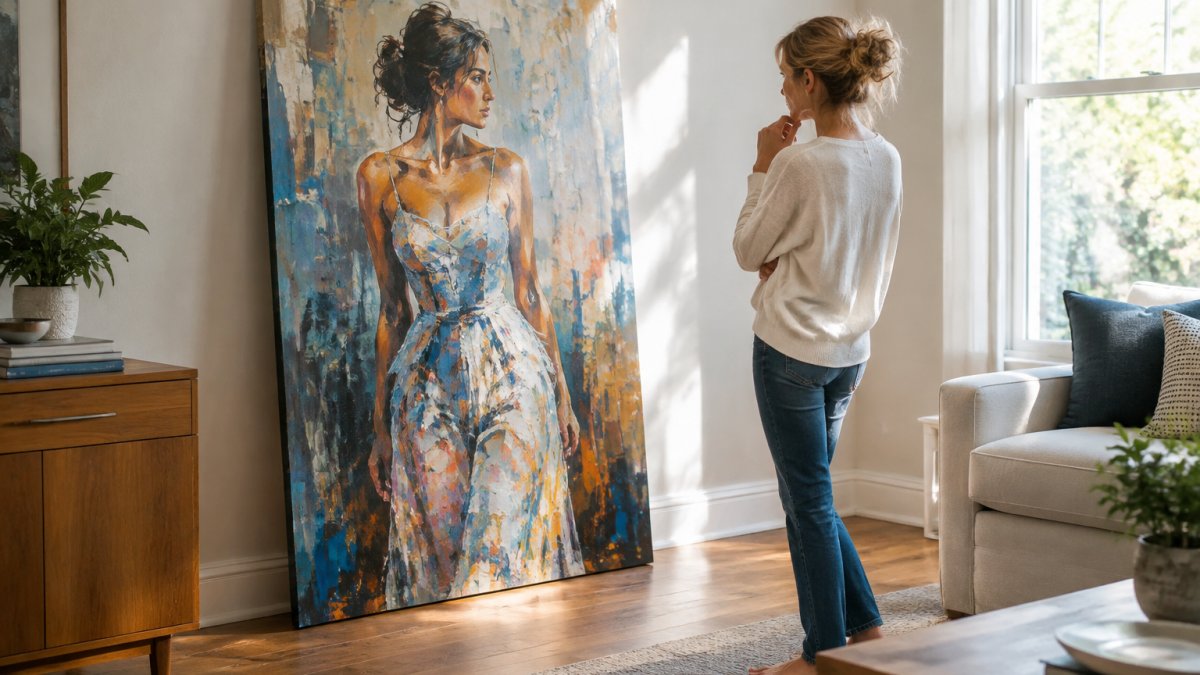
The hardest part of buying art online is trusting that a piece will feel right on your wall.
Frequently Asked Questions
How much should an original painting cost?
There is no single number, because the original painting cost reflects size, medium, and hours worked. Compare pieces at the same size and medium before deciding whether a price is reasonable.
How can I tell whether an artwork is an original or a print?
Ask for the medium in writing and look at the surface. An original oil or acrylic painting has visible texture, brushwork, and slight variations across the canvas, and it is signed and dated by the artist. A print is flat and uniform, usually numbered or marked as a limited edition. Reputable sellers list the type, dimensions, and signature details on the listing.
Are limited-edition art prints worth buying?
Limited-edition art prints are released in a fixed number, which gives them a defined scarcity. Check the edition size and whether the print is hand-embellished before you buy.
What is the difference between a giclée print and an original painting?
A giclée art print is a high-resolution reproduction printed on fine art paper or canvas, so multiple copies can exist. An original painting is the single piece the artist made by hand, which is why it carries a higher price and holds a different kind of value. Giclée prints are a practical way to bring a specific image into a room when the original is out of reach.
What should I check before buying original art online?
Confirm the exact dimensions in inches, the medium, whether the piece is framed, and the shipping cost before checkout. Ask about the return policy and how the work will be packed. Request additional photos or a virtual viewing if you are unsure about color, since screen settings can shift how a painting reads in your room.


0 comments