


Last Updated: November 12, 2026
Quick Summary
Choose narrative art for a reading nook by first deciding the mood you want, such as calm, warm, or curious, then selecting a piece that suggests a story rather than stating one. Match two or three colors from the room, and check the scale and hanging height from a seated position before buying.
- Pick three words describing the feeling you want, and test every piece against them.
- Choose wide, calm compositions like landscapes, which invite the eye to wander.
- Hang the center of the piece about 48 to 54 inches from the floor.
- Make the artwork roughly two-thirds to three-quarters of the clear wall width above your chair.
- Avoid glossy glass near windows, since glare can sit right where you look up from the page.
Table of Contents
- Start With the Mood You Want the Nook to Hold
- Step 1: Decide What the Story Should Feel Like
- Step 2: Match Color and Avoid Visual Noise
- Step 3: Choose Scale and Hanging Height for Your Chair
- Original Art Versus Prints: Which Suits a Reading Nook
- Reading Nook Wall Art Ideas for Small and Renter-Friendly Spaces
- Booking Your Narrative Piece With Annette Back Fine Art
- Frequently Asked Questions
Start With the Mood You Want the Nook to Hold
Most people choose art for a reading nook by picking what they like on a screen, then hanging it and hoping it fits. That usually goes wrong. A reading nook is a small, personal room, and the art you put in it sets the feeling you get every time you sit down with a book.
Start with the mood before the subject. Ask yourself how you want to feel when you settle in. Calm and quiet? Warm and nostalgic? Curious and a little dreamy? The answer will narrow your choices faster than any style guide.
Annette Back Fine Art creates contemporary figurative and painterly works built from layers of photography, text, and vivid color. Pieces like these can carry a story across the wall, which is exactly what a reading nook needs.
Write down three words that describe the feeling you want. Keep them in front of you while you shop. Every piece you consider should pass that test.
Step 1: Decide What the Story Should Feel Like
Narrative art tells a story without spelling it out. The viewer fills in the rest. In a reading nook, that is a strength, because reading is already about imagining what comes next.
Ask whether you want the art to continue the stories on your shelves or contrast with them. A nook full of mystery novels might suit a piece with quiet tension. A nook for gentle essays and poetry might suit something softer.
A simple test helps. Stand where your chair will sit and look at the piece for a full minute. If your eye keeps returning to it in a pleasant way, it is working. If you feel restless or want to look away, keep searching.
Calm, Nature-Led Scenes
Landscapes, horizons, and soft natural forms are among the most reliable choices for a reading corner. They invite the eye to wander without demanding attention.
- Look for wide horizons and open space around the subject
- Choose palettes that echo the light in your room
- Favor gentle movement over sharp, hard lines
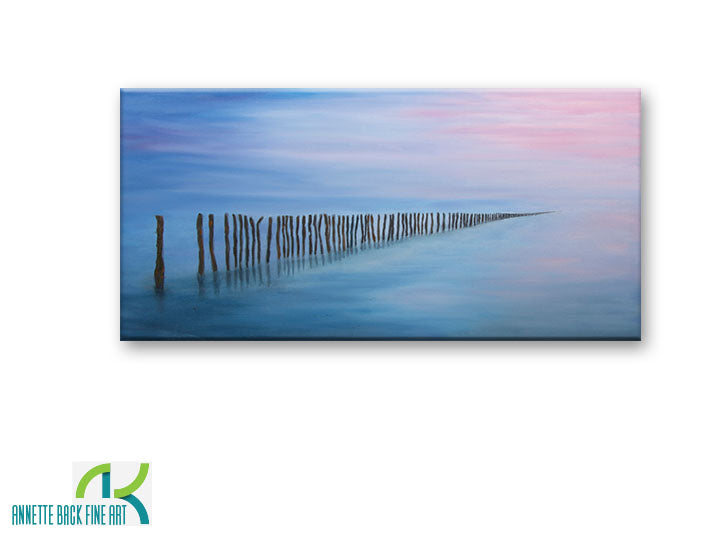
Annette Back's painting Infinity, a 48 x 24 inch original oil on canvas at $3,000.00, uses a horizontal landscape, soft blues, and an expressive, pensive mood. Its wide format suits a reading nook where you want the wall to feel open, not crowded. You can view it on the Infinity by Annette Back - 48x24 product page.
Literary Motifs and Book-Themed Pieces
Some people want art that speaks directly to a love of books. Literary motifs, such as flowing lines that suggest pages, or layered text that hints at words, can make a reading corner feel personal.
A common mistake is choosing art that is too literal. A painting covered in book titles can feel like a bookshop window. Look instead for suggestion. A few traces of text or a sense of memory works better than a full illustration of a story.
Step 2: Match Color and Avoid Visual Noise
Color does more work in a small reading nook than almost anything else. Bright red, neon, and busy patterns can make a quiet corner feel tense, even when you have chosen art you love.
Pull two or three colors from your existing room: the cushion, the rug, the lamp shade. Then look for art that includes at least one of those tones. This creates visual calm without making the piece blend in.
Watch for busy surfaces. Heavy texture, many small details, and high contrast all compete for attention. For a chair you sit in for long stretches, simpler compositions tend to hold up better over time.
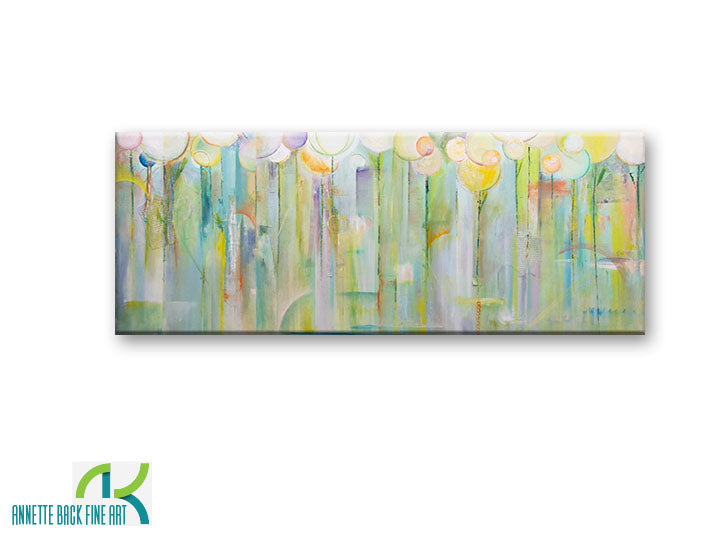
Annette Back's In Dreams, a 40 x 16 inch original oil and mixed media work at $12,240.00, uses aqua and soft circles that feel airy rather than loud. Its gentle, floating forms suit a reading corner that needs softness. See it on the In Dreams by Annette Back product page.
Keep your palette simple. Two or three dominant colors usually feel calmer than five or six competing shades.
Step 3: Choose Scale and Hanging Height for Your Chair
Scale matters as much as color. A piece that is too small looks lost above a chair. A piece that is too large can overwhelm a small corner.
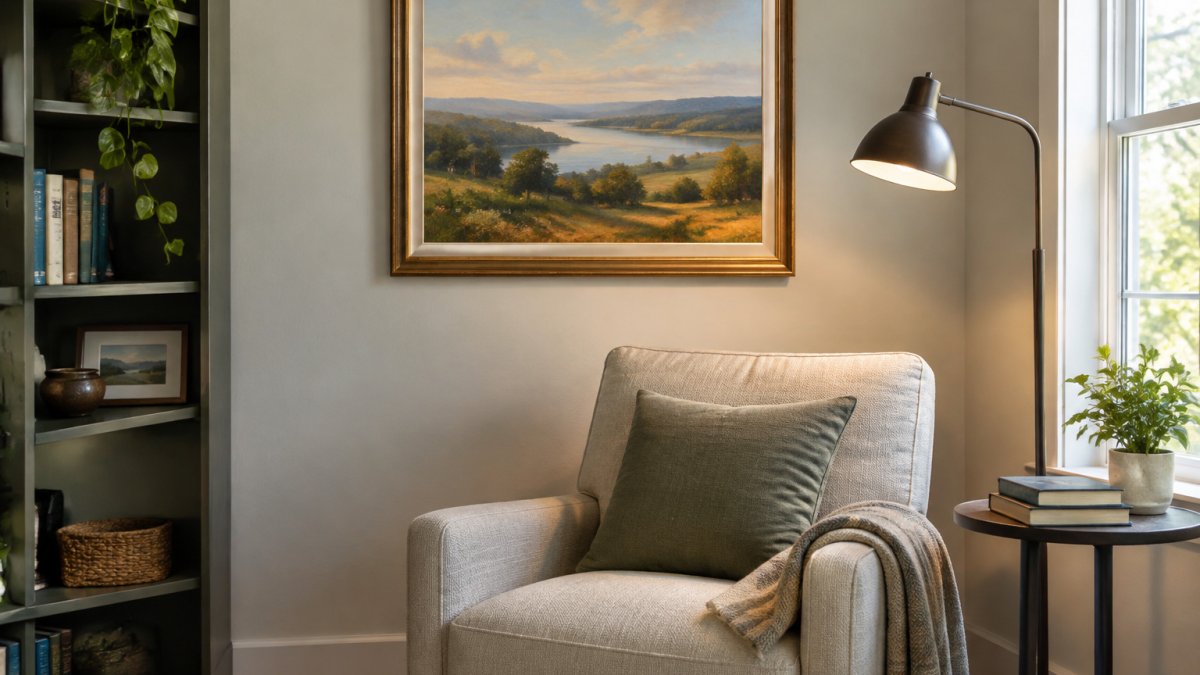
Start with the wall above your chair. Measure the clear wall width between the nearest obstacles, such as a window frame, a door casing, or a bookshelf edge.
Hanging height is where most reading nooks go wrong. The common museum guideline is to center art at about 57 inches from the floor, but a reading nook is not a hallway.
Viewing distance changes what you actually see. A useful rule of thumb is that the ideal viewing distance is about 1.5 to 2 times the diagonal measurement of the artwork.
Test before you commit. Tape a sheet of paper or a painter's tape outline on the wall at the planned size and height, sit in the chair, and check how it looks with your book open. This small step prevents most scale mistakes, and it costs nothing.
Watch out: glossy glass and direct window light are a bad pairing in a reading nook. A framed print under standard glass can throw a glare patch right where you look up from the page.
Finally, check the weight and the hardware. A large framed piece can weigh 15 to 30 pounds or more, which is more than a single drywall anchor should carry. Use two anchors rated for the load, or hit a stud.
The key measurements for a reading nook are summarised below, so you can check your wall before buying.
| Factor | Guideline | Note |
|---|---|---|
| Artwork width | 2/3 to 3/4 of clear wall width | Leave 3 to 6 inches on each side |
| Hanging height (center) | 48 to 54 inches from floor | About 6 to 10 inches above chair back |
| Viewing distance | 1.5 to 2 times the diagonal | Read best from a seated position |
| Anchors | Two rated anchors or a stud | Large frames can weigh 15 to 30 pounds or more |
| Glass | Avoid glossy glass near windows | Glare sits where you look up from the page |
Original Art Versus Prints: Which Suits a Reading Nook
Original art and prints both work well in a reading nook, but they serve different needs. An original painting is one of a kind and carries the texture and presence of the artist's hand. Prints are more affordable and easier to replace.
Prints come in several forms. Giclee prints are high-quality reproductions made with fine inkjet printing, valued for color detail. Limited edition prints are produced in a set number and often signed and numbered. Hand-embellished prints add painted or hand-applied details on top of a printed base, which blends the reach of a print with some of the feel of an original.
Many buyers look at original art vs canvas prints and wonder which is worth the difference. If the reading nook is a place you return to every day and you want a piece you will treasure, an original often feels worth it. If you are decorating a rental or want to try a style before committing, a print is a sensible start.
Owning an original also means you can commission custom work. Annette Back offers custom orders at the same price as a regular piece, and you decide whether to buy once the work is finished.
For more detail on the differences, read the guide on original art versus canvas prints or the buying original art online vs prints guide. The About Contemporary Prints page explains the print terms you will see while shopping.
Reading Nook Wall Art Ideas for Small and Renter-Friendly Spaces
Many reading nooks sit in apartments, studios, or rented rooms where you cannot make permanent changes. The good news is that you can still choose narrative art that transforms the space without drilling multiple holes, and the solutions are more specific than most guides admit.
Start by mapping the wall you actually have. A nook is often a narrow slice: the wall between a closet and a window, the end of a hallway, or the strip above a low bookshelf.
For hanging without damage, the options are better than they used to be. Removable adhesive strips rated for the weight are the standard renter solution, but check the rating against the piece: a lightweight unframed canvas may need only a pair of strips, while a framed print with glass can exceed what strips hold safely.
Small spaces reward restraint. One well-chosen piece often looks more intentional than three smaller ones competing for attention. If you want more than one, group them tightly so they read as a single unit rather than scattered dots across a wall.
Watch out: removable strips fail on textured, freshly painted, or dusty walls. Let new paint cure for at least a week before hanging, wipe the wall clean, and press the strip firmly for the full recommended time before adding weight. A piece that drops is worse than a small hole.
For more styling ideas in compact homes, see the how to style art in small apartments guide.
Booking Your Narrative Piece With Annette Back Fine Art
Once you have your mood, palette, and scale, the final step is choosing the piece itself. Annette Back Fine Art creates contemporary figurative and painterly works, including originals and limited edition prints, with a multi-layered approach.
Consider how each piece fits your three words from the start. Check the size, the palette, and the feeling against your chair and your wall. If you want something made for your corner, you can ask about a custom order.
Browse the available work, compare sizes against your measured wall, and choose the piece that makes you want to sit down with a book.
Frequently Asked Questions
What is narrative art?
Narrative art is artwork that suggests a story, a moment or an emotional situation rather than simply showing an object or scene. In a reading nook, it works because it invites the eye to linger, much like a good book does. Figurative and painterly pieces with layered imagery, text traces or evocative landscapes often read as narrative. The strongest choices leave room for the viewer to fill in the story themselves, which suits a space meant for quiet reflection.
What size artwork works above a reading chair?
A piece that is roughly two-thirds to three-quarters the width of the chair back usually looks balanced above a reading chair. A 48-inch wide horizontal canvas, such as Infinity by Annette Back Fine Art priced at $3,000.00, suits a large chair or sofa wall, while a 24-inch square like Space at $1,500.00 suits a smaller armchair. Measure the wall and the furniture before you buy, and leave enough clearance above the chair back.
Should I choose an original painting or a print for a reading nook?
An original painting gives you texture, brushwork and a one-of-a-kind presence that suits a personal reading space. A limited edition print or a hand-embellished print can deliver a similar narrative mood at a lower price point and is easier to replace or move. If the nook is a place you return to daily and you want a focal piece, an original is worth the investment. If you are furnishing several spots or renting, a print can work well.
How high should I hang art in a reading nook?
Hang the center of the artwork at roughly eye level when you are seated, which is typically a little lower than standard gallery height. Leave a gap of about 8 to 12 inches between the top of the chair back and the bottom of the frame so the piece does not feel crowded. Check the placement with painter's tape before you drill, and view it from the seat, since that is the angle that matters most in this space.


0 comments