


Last Updated: November 8, 2026
Quick Summary
To style large scale mixed media art in a modern home, start by matching the piece to the wall and the furniture below it, aiming for roughly two-thirds to three-quarters the width of the sofa. Center the artwork at about 57 to 60 inches from the floor, leaving 6 to 10 inches above a sofa back.
- Measure the wall width and the furniture width before you buy or hang anything.
- Aim for a piece roughly two-thirds to three-quarters the width of the sofa below it.
- Center the artwork at about eye level, usually around 57 to 60 inches from the floor.
- Leave 6 to 10 inches between the sofa back and the bottom edge of the artwork.
- Balance a textured piece with smooth, quiet elements such as slim sconces or lamps.
Table of Contents
- Start With the Scale of Your Wall
- Placing Large Scale Mixed Media Art Above a Sofa or Fireplace
- What to Put on Either Side of a Large Painting on Wall
- How to Mix Art in a Room Without Visual Clutter
- How to Display a Hand-Embellished Print Alongside Mixed Media Work
- Lighting, Framing and Care for Mixed Media Pieces
- Choosing Your First Large Piece for a Modern Room
- Frequently Asked Questions
Start With the Scale of Your Wall
Large scale mixed media art can transform a room, but only when it fits the wall it hangs on. A common mistake is a piece chosen for its colors, then hung too small or too high to hold its own. Getting the scale right comes first, and everything else follows from it.
Think of a large piece as an anchor. It should feel like the main event in the room, not something squeezed into a leftover gap. A general rule many interior designers follow is to leave a clear margin on either side of the artwork rather than letting it touch the edges of the wall.
Measuring the wall and the furniture below it
Before you buy or hang anything, measure two things: the wall and the furniture underneath it.
- Measure the wall width. Note the distance between corners, windows, or doorframes.
- Measure the furniture width. Sofas, consoles, and beds set the visual base for the artwork.
- Aim for proportion, not an exact match. A piece that is roughly two-thirds to three-quarters the width of the sofa often looks balanced.
- Check the height. Center the artwork so its middle sits at about eye level, usually around 57 to 60 inches from the floor.
Write these numbers down before you shop. Sizing mistakes are a common reason large art disappoints once it arrives.
Placing Large Scale Mixed Media Art Above a Sofa or Fireplace
A large piece above a sofa or fireplace is the classic statement placement. It works because the furniture below creates a natural frame for the art.
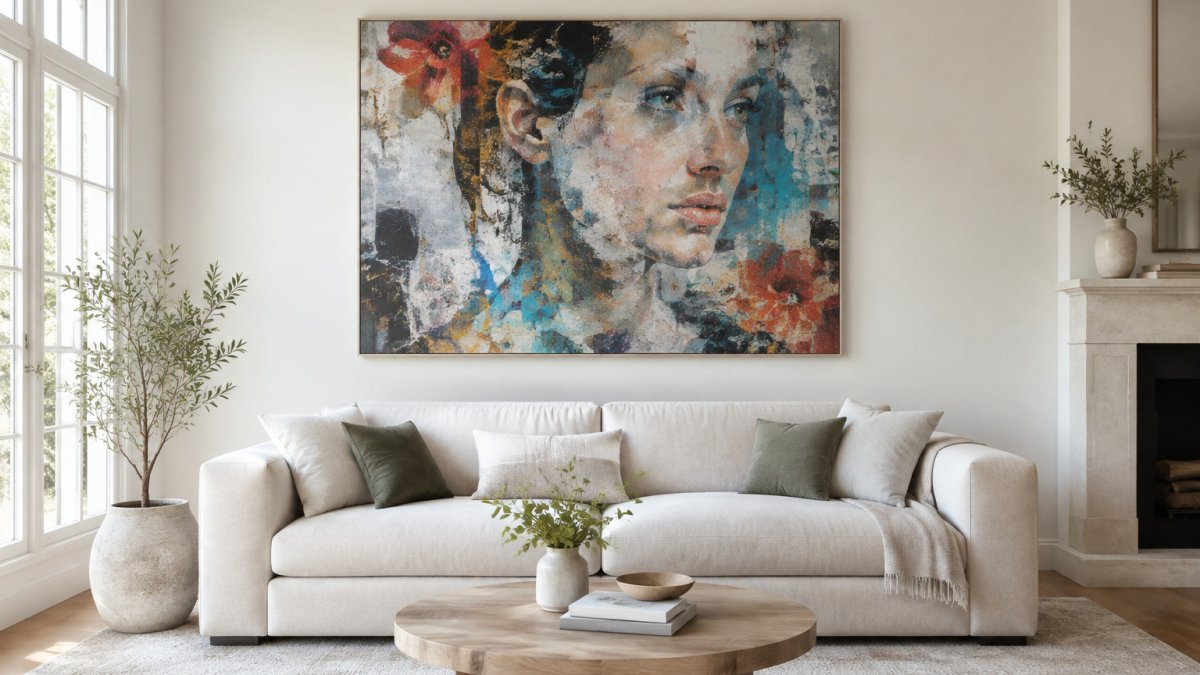
Leave roughly 6 to 10 inches between the top of the sofa back and the bottom edge of the artwork. Too much space makes the two feel disconnected. Too little can make the piece feel cramped against the cushions.
Over a fireplace, the mantel becomes part of the composition. Keep the artwork centered on the firebox and make sure the mantel and wall above it do not compete with the painting for attention.
Here is a quick placement guide:
| Setting | Suggested gap or position | Why it works |
|---|---|---|
| Above a sofa | 6 to 10 inches above the sofa back | Connects the art to the furniture |
| Above a fireplace | Centered on the firebox | Creates a clear focal point |
| Standalone wall | Eye level, centered | Gives the piece room to breathe |
Watch out: hanging a large piece too high is the most common error. If you find yourself standing on a stool to view it comfortably, lower it.
What to Put on Either Side of a Large Painting on Wall
Large mixed media art rarely works alone, but the challenge is different from styling around a flat painting. A mixed media piece already carries multiple textures, materials, and dimensional elements within its own frame. What sits on either side must support that complexity without adding visual noise.
The core principle is restraint through contrast. If the artwork is textured and layered, the flanking elements should be smooth and quiet. If the piece is dark and dense, the sides should be light and open. Think of the wall as a composition where the art is the lead voice and everything else is accompaniment.
Matching visual weight, not just height
A common mistake is choosing side elements that match the artwork's height but not its visual weight. A large mixed media piece with heavy texture and deep color has more visual weight than a flat print of the same size. Balance it with elements that are physically smaller but visually solid, such as a pair of ceramic table lamps with wide shades, or a single sculptural floor lamp with a strong base.
- Two matching sconces work when the artwork is wide and horizontal. Choose slim, low-profile designs that do not cast harsh shadows on textured surfaces.
- A pair of floor lamps flanking a sofa-width piece should have shades that sit below the artwork's midpoint, so the light washes upward rather than glaring across the surface.
- A console table below the art can hold two low objects, such as a ceramic bowl and a stack of books, but keep the objects shorter than the gap between the table and the bottom of the frame.
- A narrow vertical mirror on one side can echo the height of a tall piece, but avoid placing it where it reflects direct light onto the artwork's surface.
Styling around a visually complex focal piece
When the mixed media work has strong dimensional elements, such as raised texture, embedded materials, or visible brushwork, the surrounding area should recede.
A useful test is to stand back and squint. If the side elements compete with the artwork for attention, remove one. Most practitioners find that fewer, larger side elements work better than many small ones because they create a clear rhythm without clutter.
Watch out: placing a tall, busy plant or a highly patterned textile directly beside a textured mixed media piece can make the wall feel chaotic. Move the plant to a corner and let the artwork breathe.
How to Mix Art in a Room Without Visual Clutter
Mixing originals with smaller prints or other pieces can look rich and collected, or it can look scattered. The difference usually comes down to a few deliberate choices.
Pick one large piece as the primary focal point. Everything else should play a supporting role. Then connect the smaller pieces to the large one through one shared element, such as a color, a frame finish, or a repeated shape.
Practical tips:
- Keep a consistent frame color or material across the group.
- Hang smaller pieces in a loose cluster rather than a rigid grid.
- Leave wall space between groupings so each one reads clearly.
- Vary orientation (vertical and horizontal) to add interest without chaos.
A common mistake is hanging too many pieces of similar size. Vary the scale so the eye knows where to land first.
How to Display a Hand-Embellished Print Alongside Mixed Media Work
Hand-embellished prints add texture and personal detail to a print, which makes them a natural companion to mixed media originals. Displayed together, they can share a wall without competing if you treat them as a single composition.
Start by matching the tone of the two works, not their exact style. Warm colors in the print can echo a warm accent in the original, for example. Then consider the frame.
Place the embellished print at a slightly smaller scale than the original, and position it to the side or below the larger piece rather than directly beside it at the same height. This keeps the original as the clear anchor.
Lighting, Framing and Care for Mixed Media Pieces
Mixed media art demands more attention to lighting and care than a flat painting because its surface changes with the angle of light. Raised texture, metallic elements, and varied materials catch light differently throughout the day, so the same piece can look warm in morning sun and cool under evening lamps. Test placement at different times before committing to a wall.
Lighting textured and reflective surfaces
Indirect or filtered light is generally a safer choice for displaying art. North-facing walls provide consistent, cool light that suits most mixed media pieces, while south-facing walls need sheer curtains or UV-filtering film.
For accent lighting, a picture light mounted above the frame can bring out texture after dark, but position it so the light grazes the surface rather than hitting it straight on. A wall wash from a ceiling fixture works well for large pieces because it spreads light evenly without a hot spot. Avoid spotlights that create harsh shadows across dimensional elements.
Framing to protect mixed materials
A clean, simple frame lets the surface and textures do the talking, but the frame also plays a protective role. For pieces with raised texture, choose a frame with enough depth to keep the glazing off the surface. Acrylic glazing is lighter than glass for large pieces. If the work includes fragile elements, consider a shadow box frame that encloses the piece without pressing on it.
Safe installation for heavy or oversized pieces
Large mixed media works can be heavier than they look, especially when framed with glass or mounted on a solid backing. Use wall anchors suited to the weight of the piece, and drive them into studs whenever possible.
Check the wall clearance behind the frame. A piece that sits flush against the wall can trap moisture and damage the backing. Small rubber bumpers on the bottom corners keep the frame slightly off the wall and allow air to circulate.
Care and material protection
Dust gently with a soft, dry brush or lint-free cloth. Keep the piece away from humidity and heat sources, such as bathrooms and fireplaces.
Watch out: hanging a heavy piece on drywall without anchors or studs can lead to falls and damage. If you are unsure about the weight or the wall, consult a professional installer before you hang.
Choosing Your First Large Piece for a Modern Room
Your first large piece should feel like a confident choice, not a leap into the unknown. Start with the room you use most and the wall that gets the most attention.
Consider these questions before you decide:
- Does the piece fit the wall width with comfortable margins on either side?
- Do the colors work with the rest of the room, even if the room is neutral?
- Will you enjoy looking at it every day, not just when guests visit?
- Is the scale right for the furniture it will hang above?
Original works and prints both have a place in a modern home. If you want to compare the two before you choose, our guide on buying original art online versus prints walks through the differences in value, texture, and presentation. Our page on Annette Back's original paintings shows a large-scale mixed media piece that is well suited to a sofa or fireplace wall. For a closer look at how a hand-embellished print works alongside original work, see Horizon.


Mixed media art has a strong effect in a modern room because it adds depth, emotion, and texture to a space. Start with the scale, respect the furniture below it, and let one piece lead. The rest of the room will follow.
Frequently Asked Questions
How high should large artwork hang on a wall?
A common starting point is to center the artwork at about 57 to 60 inches from the floor, which is roughly eye level for most adults. When a large piece hangs above a sofa or console, leave about 8 to 12 inches between the furniture top and the bottom of the frame so the two read as one grouping. Adjust for ceiling height and the sightlines in your room, and tape a paper template of the piece to the wall before you drill anything.
How do you mix different art styles in one room?
Tie mismatched pieces together through one shared element, such as a repeated color from the mixed media work, a consistent frame finish, or a similar scale. Place one large statement piece as the visual anchor and let smaller works play a supporting role. Mixing a figurative painting with a textured abstract works when the palettes overlap, and it becomes harder when they fight for attention.
What should you put on either side of a large painting?
Flanking a large painting with a pair of sconces, slim console tables, or two smaller works of equal visual weight creates balance. Mirrors and plants also work well, especially where the large piece sits between windows. Keep the flanking objects lower in height than the central artwork so the painting remains the focal point.
How do you display a hand-embellished print?
Hang them at the same height as neighboring art and avoid stacking heavy objects in front of the surface.


0 comments