


Last Updated: November 4, 2026
Quick Summary
Artfully Walls alternatives for modern homes include matte photo prints from $120, gallery wrap canvases from $40 to $450, hand-embellished editions from $150 to $600, and originals on a commission basis. Each format solves a different problem, from affordable entry points for renters to statement pieces with long-term value.
- Limited editions are signed and numbered, making them collectibles with a defined supply rather than decor.
- Test one adhesive strip for 24 hours before committing a gallery wall to damage-free hardware.
- Above a sofa, art should span about two-thirds to three-quarters of the furniture width.
- Angle a picture light across the surface rather than straight at it so texture reads properly.
- A commission suits walls with odd proportions or rooms no existing piece matches.
Table of Contents
- What Modern Homes Actually Need From Wall Art
- How Artfully Walls Alternatives Compare: Prints, Canvases, and Originals
- Fine Art Photography Prints and Multi-Layered Canvas Editions
- How to Hang and Display Art at Home Without Damaging Walls
- The Value of Owning Original Art in a Modern Interior
- Commissioning Custom Artwork for a Specific Space
- Choosing the Right Piece for Your Rooms
- Frequently Asked Questions
What Modern Homes Actually Need From Wall Art
Modern interiors have changed faster than the wall decor industry has. Open floor plans, white walls, and large windows demand art that holds its own at scale, and buyers increasingly want pieces with a story rather than mass-produced decoration. That shift is why so many people are searching for artfully walls alternatives for modern homes: they want art that feels personal, not catalog-picked.
At Annette Back Fine Art, we build every piece around a multi-layered approach that combines photography, text, and vibrant color into a narrative. That matters because the modern home needs three things from wall art: visual weight, an emotional anchor, and materials that age well. A piece that only matches the sofa will be replaced in two years. A piece that says something will stay.
How Artfully Walls Alternatives Compare: Prints, Canvases, and Originals
Three formats dominate the modern wall: paper prints, gallery-wrapped canvas, and original work. Each solves a different problem. Paper prints are the most affordable entry point and suit renters who move often. Canvas wraps arrive ready to hang. Originals carry the strongest long-term value because there is only one.
The trade-offs are real. For a deeper look at how these formats stack up, see our breakdown of buying original art online versus prints, and if you are weighing canvas specifically, read original art versus canvas prints.
| Format | Starting Price | Framing Needed | Best For |
|---|---|---|---|
| Matte photo print | $120 | Yes, standard 11x14 | Renters, first-time buyers |
| Gallery wrap canvas | $40-$450 | No, ready to hang | Open-plan living rooms |
| Hand-embellished edition | $150-$600 | No, or artist-framed | Collectors wanting texture |
| Original painting | Commission basis | Artist-arranged | Statement walls, long-term value |
Fine Art Photography Prints and Multi-Layered Canvas Editions
Fine art photography prints are reproductions of an artist's original imagery, often released in signed, numbered editions. The distinction matters: an unlimited print is decor, while a limited edition is a collectible with a defined supply.
Our limited editions are signed and numbered. The Leaves set of two hand-embellished canvases ($450) layers a single leaf shape in fall colors with touches of gold leaf, and the Branches set of four ($399) takes one branch line and develops it into four separate color moods. Customer Robert Weinberg put it this way: "Bright, dynamic, textured, they are certainly eye catchers that brighten up the home." For a broader explainer on print types, see contemporary prints explained.
How to Hang and Display Art at Home Without Damaging Walls
The most common mistake is hanging everything at eye level without measuring the room's proportions. Art should relate to the furniture below it. As a general design guideline, a piece or grouping is often sized to span a good portion of the width of the sofa or console beneath it. On a wall with no furniture beneath it, treat the art as its own anchor and center it at the same height so the sight line stays consistent from room to room.
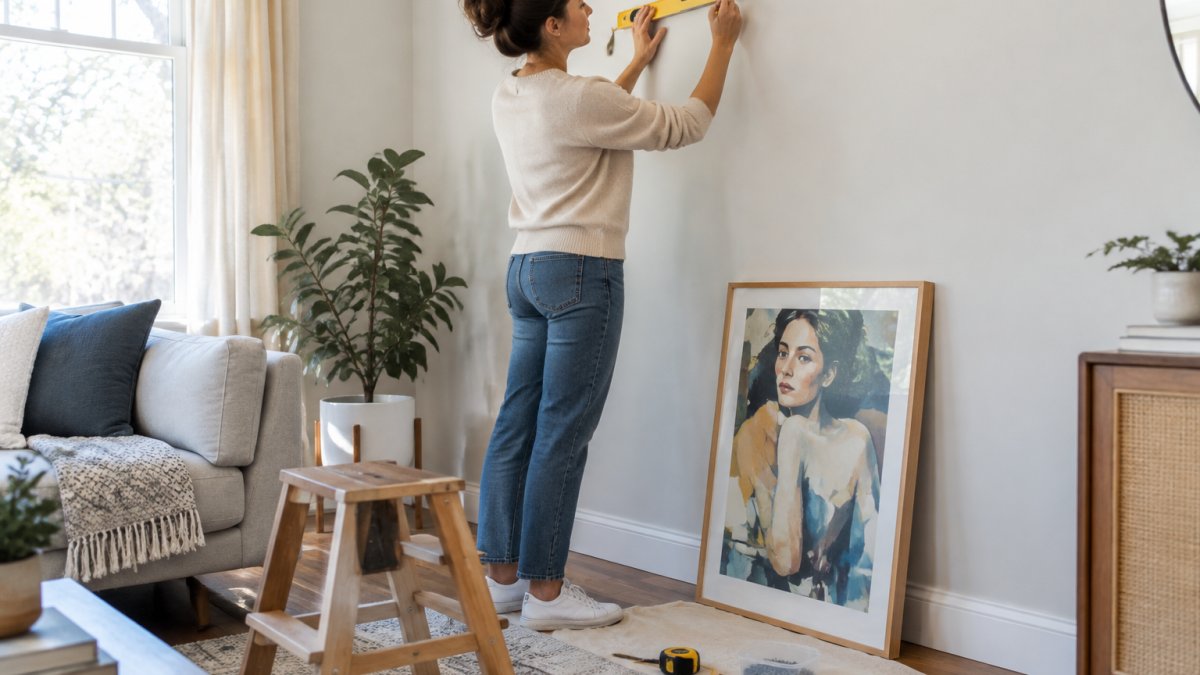
For rentals and freshly painted walls, damage-free hardware is the answer, but the method matters as much as the hardware. Work through it in this order:
- Weigh the piece first. Check the weight rating on any adhesive hanging product against the actual weight of the art.
- Clean the wall. Adhesive strips bond to dust and fail slowly, so wipe the spot with a damp cloth and let it dry completely.
- Test one strip for 24 hours. Press a single strip in place, hang nothing on it, and check it the next day. If it holds, commit the rest of the wall to the same method.
- Use two points, not one. A single hook lets a canvas pivot and drift out of level. Two strips set a few inches apart keep the piece square.
- Add a small nail in a stud for heavier work. A single small nail in a stud will hold a heavier framed piece without a deposit-eating hole, and the hole is small enough to fill with spackle in minutes.
Watch out: adhesive strips fail on textured walls, on wallpaper, and on paint that has not fully cured, so test one strip for 24 hours before committing a whole gallery wall to it.
Lighting also changes how a piece reads, and placement relative to windows and light sources matters. Angle a picture light or a floor lamp across the surface rather than straight at it, and the texture in a hand-embellished piece will read properly. For a gallery wall, one light source washing across the whole grouping reads calmer than a separate lamp per frame. If the room has track lighting, aim the heads at roughly 30 degrees off the wall so the light grazes the surface instead of bouncing back at the viewer. For a deeper look at how formats affect hanging and framing, see our breakdown of buying original art online versus prints, and if you are weighing canvas specifically, read original art versus canvas prints.
The Value of Owning Original Art in a Modern Interior
Original art holds a single point of view that no one else owns, which is central to its appeal.
Leaves - Limited Edition/ Hand Embellished/ Gallery Wrap →
There is a practical argument too. Originals anchor a room in a way that decor cannot, because they are not replaceable. Customers Sharon and Oskar Salamon noted that "the paintings have a special place in our newly renovated apartment and are often admired by friends who come to visit." That is the difference between filling a wall and giving it a focal point.
Commissioning Custom Artwork for a Specific Space
A commission solves the problem prints cannot: exact fit. When a wall has an odd proportion or a room has a color palette that no existing piece matches, a commissioned work is built to the space rather than adapted to it.
If you are ready to start, you can explore the commissions offering and begin the conversation.
Choosing the Right Piece for Your Rooms
Start with the room's job, not its color scheme. A living room needs one large anchor; a hallway needs rhythm across several smaller pieces; a bedroom needs calm. Abstract prints suit minimalist rooms because they add texture without competing. Figurative pieces and botanical compositions bring warmth to rooms that feel cold.
Scale is where most buyers go wrong, and it is the one thing you can measure before you buy. A small piece on a large wall looks lost, and a large piece in a tight room feels oppressive. Use these ratios as a starting point:
- Above a sofa or console: the art or grouping should span about two-thirds to three-quarters of the furniture width. A 72-inch sofa wants a grouping roughly 48 to 54 inches wide.
- On a bare wall with no furniture: let the piece fill about 60 to 75 percent of the available wall width, and keep at least 6 to 8 inches of breathing room on each side.
- Above a bed: the art should be no wider than the headboard and no narrower than about half of it, hung so the bottom edge clears the headboard by 6 to 10 inches.
- In a hallway: keep the center line consistent across every piece so the eye reads rhythm rather than a scatter of frames.
- In a tight room: a single vertical piece uses height without crowding the floor plan, which is why tall narrow walls suit one strong canvas better than a row of small frames.
Measure the wall, subtract the furniture width, and let the art fill most of the remaining space. Then check the viewing distance: a piece meant to be seen from across an open-plan room needs more visual weight than one you pass at arm's length in a hallway.
For buyers exploring print editions, browsing the limited edition prints collection gives a sense of the sizes and pairings available, and if a wall has an odd proportion that no standard size fits, a commission is the cleaner solution than forcing a piece that is almost right.
Frequently Asked Questions
What is the 3-5-7 rule for hanging art in a modern home?
The 3-5-7 rule is a guideline for grouping odd numbers of pieces, such as three small prints, five medium frames, or seven objects on a shelf. Odd numbers create visual balance without looking symmetrical. Pair it with a consistent center line and even spacing between frames. In a modern room, keep the group tight enough to read as one focal point rather than scattered decor.
How do I know a print will match my living room colors before it arrives?
Ask for a photo of the actual print in daylight and check the listed materials and dimensions. Hand-embellished editions vary slightly because the artist adds gold leaf or paint by hand, so expect small differences from the screen image. If color matching is critical, request a consultation or virtual viewing before ordering, and confirm the return policy for prints.
What is the difference between giclee prints and original hand-embellished art?
A giclee print is a high-resolution reproduction printed on canvas or paper. A hand-embellished print starts as a reproduction, then the artist adds paint or gold leaf to selected areas, so each piece in the edition is slightly unique. Limited editions are signed and numbered, which gives them more collectible value than open-edition prints.
Can I commission custom artwork for a specific wall size?
Yes. Commissioning custom artwork lets you set the dimensions, color palette, and subject before the artist begins. Share the wall measurements, photos of the room in natural light, and any themes you want explored. Expect a discussion of timeline and budget up front, and ask whether you will see a sketch or progress images before the final piece is completed.
Does artwork need to match the existing decor of a room?
Art does not need to match furniture exactly. It should connect through one or two elements, such as a shared color, a similar texture, or a repeated shape. A bold abstract print can sit in a minimalist room as the focal point. Mixing styles works when scale and spacing are consistent, so measure the wall and keep gaps between pieces even.


0 comments