


Last Updated: November 9, 2026
Quick Summary
An original painting is a single work the artist created by hand on a surface such as canvas, paper or board, with no master file or copies behind it. Every mark, layer and brushstroke belongs to that one object, which is why it is one of a kind. Each original at Annette Back Fine Art is hand painted, signed and dated by the artist.
- An original painting has real paint texture, ridges and brush direction that a print lacks.
- Examine the surface under raking light and with a 10x jeweler's loupe to tell an original from a print.
- A print shows a regular grid of tiny dots, while an original shows continuous pigment and canvas weave.
- Originals from Annette Back Fine Art are signed and dated by the artist and have sides stapled on the back.
- Buying an original transfers the physical object but generally not the copyright or reproduction rights.
Table of Contents
- Defining an Original Painting
- Original Painting vs. Print: The Core Difference
- How to Tell If a Painting Is Original or Print
- The Artist's Hand and Artistic Intent
- Limited-Edition Art Prints and Hand-Embellished Prints
- Why One-of-a-Kind Works Hold Their Value
- Choosing Your Original Piece at Annette Back Fine Art
- Frequently Asked Questions
Defining an Original Painting
An original painting is a single work the artist created by hand on a surface such as canvas, paper or board. There is no master file behind it and no run of identical copies. Every mark, layer and brushstroke belongs to that one object.
That is what makes an original painting one of a kind. At Annette Back Fine Art, each original is hand painted and signed and dated by the artist. The work exists in one place, and nothing else quite like it will ever be made.
An original painting is more than a picture. It carries the record of the artist's decisions, from the first underpainting to the last glaze. Two people looking at the same subject would never produce the same surface.
Original Painting vs. Print: The Core Difference
A print is a reproduction of an image, made by a machine or a press, from a digital file or a plate. An original painting is the image itself, made by hand.
The difference shows up in three places:
- Surface: An original has real paint texture, ridges and brush direction. A print has a flat, even surface.
- Quantity: An original exists once. A print can be run many times.
- Value: Collectors pay for the unique object. A print's worth depends on its edition, paper and reproduction quality.
Many people first meet an artist's work through a print, and that is a fine way in. If you want to see the difference for yourself, browse the original paintings from Annette Back Fine Art and compare them with a printed reproduction of the same style. Standing in front of the real surface makes the gap obvious.
The table below sums up how an original painting differs from a print across the three points that matter most to buyers.
| Aspect | Original painting | |
|---|---|---|
| Surface | Real paint texture, ridges and brush direction | Flat, even surface |
| Quantity | Exists once | Can be run many times |
| Value | The unique object | Edition, paper and reproduction quality |
How to Tell If a Painting Is Original or Print
Most guides stop at "look closely." That is not enough, because modern giclee printing can mimic canvas texture and brushwork convincingly. The reliable way to tell an original painting from a print is to examine the surface at magnification and under different light. You do not need a lab, a jeweler's loupe and a small UV flashlight cover most of the work.
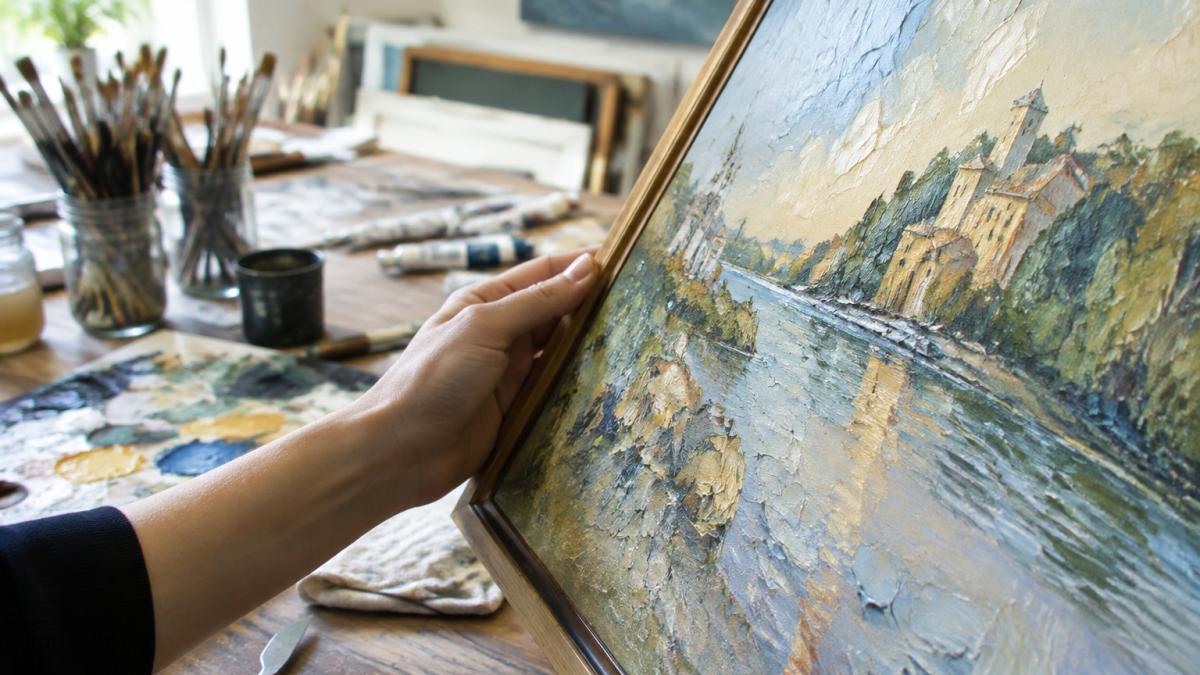
Checking Brushwork, Texture and Surface
Start with raking light. Hold a lamp low and to the side of the piece so the beam skims across the surface. On an original, the paint casts small shadows: ridges where the brush lifted, thicker passages of impasto, and edges where one color sits physically above another.
- Look for raised paint and visible brush direction that changes from area to area.
- Check where two colors meet. Hand-painted edges wobble and overlap slightly; printed edges tend to be crisp and uniform.
- Be cautious of a surface that is perfectly flat and even, which often signals a print.
Watch out: some reproductions are textured on purpose to imitate canvas weave and brush marks. Texture alone is not proof.
Using a Loupe to Spot Print Dots vs. Paint Layers
A jeweler's loupe (10x is enough) settles most questions. Place it flat against the surface and look at a mid-tone area, not the white margin.
- On a print: you will see a regular grid of tiny dots, the halftone or inkjet dot pattern, or a uniform spray of microscopic ink droplets. The dots sit in rows and repeat across the surface.
- On an original painting: you will see continuous pigment, the edge of a brushstroke, canvas weave under the paint, and sometimes the slight ridge where one layer overlaps another. There is no repeating dot grid.
Compare several spots. A print's dot pattern is consistent everywhere; an original's surface varies from passage to passage.
Using UV Light to Read the Surface
A small UV flashlight reveals things visible light hides. Many modern printing inks and coatings fluoresce differently from oil or acrylic paint.
- Shine the UV light across the surface in a dark room. A bright, even glow across the whole image often indicates a printed coating or varnish layer.
- Look for a duller, uneven response on an original, where different pigments and layers react differently.
- UV also helps spot later retouching or overpainting on an original, which shows as a different glow from the surrounding paint.
Watch out: UV results vary by medium and by the varnish used, so treat fluorescence as one clue among several, not a verdict on its own.
Looking at the Signature, Dating and Edges
Look for an artist's signature and a date, usually on the front corner or the back. Originals from Annette Back Fine Art are signed and dated by the artist.
Check the sides and back of the canvas. Originals from Annette Back Fine Art have their sides stapled on the back. A print is often mounted or wrapped differently, and a paper print may show a distinct border or deckled edge where it was trimmed.
If a seller cannot tell you where a work was made, or who made it, ask for documentation before you buy. A certificate of authenticity, a receipt, and the artist's own records are the paper trail that backs up what your loupe and UV light suggest.
The Artist's Hand and Artistic Intent
The strongest reason to own an original is the artist's hand. Every layer records a choice: where to press, where to scrape, where to let paint run. Those choices are what give a piece its visual depth and emotional pull.
Artistic intent matters too. An artist building a work around personal memory, social themes or a single idea makes decisions that a reproduction cannot carry. You can see the layering of photographs, text and color in a Annette Back piece, and you feel how the work was built up over time.
Limited-Edition Art Prints and Hand-Embellished Prints
Prints are not inferior. They are a different product, and they serve a different need.
A limited-edition print is produced in a numbered run, and the edition size is fixed. Giclee prints use high-quality inkjet printing for fine color fidelity. The edition number tells you how many exist.
A hand-embellished print starts as a reproduction and is then finished by hand. The artist adds paint, gold leaf or other marks directly to each print. Each piece therefore differs slightly from the others in the edition.
Consider the Leaves Limited Edition Hand Embellished Gallery Wrap, which shows how hand finishing adds individual character to a reproduction. You can also compare the Happy Limited Edition Hand Embellished Gallery Wrap for another example of this approach.


Prints work well when you want the look of a piece at a lower price, or when you want to fill several walls.
Why One-of-a-Kind Works Hold Their Value
Collectors generally value originals because there is only one. Scarcity, provenance and the artist's documented body of work all shape demand. An original is a physical object that cannot be replaced by a copy, and that single fact does most of the work in the market.
Scarcity, Provenance and Documentation
Scarcity is simple: one painting, one owner. Provenance is the record of where the piece has been, who bought it and when. A clean provenance chain makes a work easier to resell or pass on, and buyers pay attention to it.
Good documentation helps. Keep the certificate or receipt, the artist's details and any record of the piece's history. These papers are what a future buyer, insurer or appraiser will ask for first.
What You Own, and What You Don't
This is where many new collectors get confused. Buying an original painting transfers the physical object. It does not, by default, transfer the copyright or the right to reproduce the image.
Under U.S. copyright law, the artist generally retains the reproduction rights unless those rights are explicitly assigned in writing. That means the owner of a painting can hang it, lend it, insure it and resell the physical object, but cannot make prints, post high-resolution reproductions for commercial use, or license the image without the artist's permission.
A common pattern is that buyers assume the purchase includes the image rights. It usually does not. If reproduction rights matter to you, ask for a written agreement that spells out what is and is not included.
Digital Originals and the One-of-a-Kind Question
Digital art and NFTs have muddied the phrase "one of a kind." A digital original can be unique as a token or file, but it is not a physical object with paint layers, texture and a hand-made surface. The two are different categories of ownership, and they are valued differently.
For a collector who wants the physical record of the artist's hand, the actual surface the artist built up over time, a painted original remains the clearest example of a one-of-a-kind work.
Value is not guaranteed, and nothing here is a financial forecast. Buy because you love the work. Treat any growth in value as a bonus, not the reason to buy.
Choosing Your Original Piece at Annette Back Fine Art
Start by deciding where the piece will hang, then think about size and mood. A large work anchors a room. A smaller piece suits a hallway or a reading nook.
Browse the current selection and read each description for the artist's intent. Consider these examples:

- Herzl Sees You by Annette Back: An original portrait with quotes and symbolism in the background, priced at $1,100.00.
- In Dreams by Annette Back, 40x16: An original oil on canvas inspired by flowers, priced at $12,240.00.
- Hold Me by Annette Back, 24x36: A featured original painting that explores long-lasting love through a deeply intimate pose. View it on the Annette Back Fine Art original paintings page.
Looking at pieces before you buy is a good way to judge whether a work fits your space and your taste.
Frequently Asked Questions
How do I tell if a painting is an original?
Start by looking at the surface. Original paintings show brushstrokes, paint buildup and texture that vary across the canvas, while prints usually appear flat and uniform under raking light. Check the edges of the canvas for staples or wrap, look for a hand-applied signature and date, and ask the artist or gallery for provenance. Be cautious of any seller who cannot describe the medium or the creation process of the work.
What is the difference between an original painting and a reproduction?
An original painting is the singular work the artist created by hand, usually in oil or acrylic on canvas or panel. A reproduction, including a giclee or offset print, is a mechanical copy of that image, even when it is high quality. Originals carry the artist's direct marks and are one of a kind, while reproductions are made in multiples and reflect the image rather than the physical act of painting.
Can a limited-edition print be considered original art?
A limited-edition print is a reproduction, not an original painting, but it is often a valued collectible when the edition is numbered, signed and capped in size. Hand-embellished prints, where the artist adds paint or marks to each print by hand, sit between the two categories and can be meaningfully unique. Ask whether each piece was touched by the artist and how many copies exist.
What makes owning an original painting special?
Owning an original means living with a single object the artist made, with its own texture, layering and history. Original works at Annette Back Fine Art are signed and dated by the artist and are hand painted, so each piece is a direct record of the artistic process. Many buyers value that connection and the visual depth that prints cannot fully reproduce.


0 comments