


Quick Summary
Choose a canvas print size by measuring the wall first, then picking a canvas that covers about 60 to 75 percent of the furniture width below it. Match orientation to the wall shape and check that the file's aspect ratio fits the canvas to avoid cropping.
- Measure the wall width and height before choosing any canvas print size.
- Aim for art that covers roughly 60 to 75 percent of the furniture width.
- Use portrait orientation for tall or narrow walls and landscape for wide walls.
- Compare your file's aspect ratio to the canvas ratio to avoid cropping.
- Tape a paper cutout to the wall and live with it before ordering.
Table of Contents
- Start With Your Wall: How to Measure a Wall for Art
- Understanding Canvas Print Sizes in Inches
- Using the 60-75% Rule and Proportion for Furniture
- Portrait vs. Landscape: Choosing Orientation and Aspect Ratio
- Resolution, Print Quality and Why Your File Matters
- Lighting, Viewing Distance and Previewing Your Size on the Wall
- Planning Your Canvas Prints on Wall for a Finished Look
- Next Steps: Hanging a Large Portrait Painting With Confidence
- Frequently Asked Questions
Start With Your Wall: How to Measure a Wall for Art
Last Updated: November 3, 2026
Choosing the right canvas print size starts with the wall, not the artwork. Many buyers fall in love with a piece online, only to find it too small or too large once it reaches the wall. A few minutes with a tape measure prevents that.
Measure the wall space first. Note the width and height of the area where the piece will hang, then decide how much of that space the art should fill.
Measuring Width, Height and Eye Level
Start by measuring the full width of the wall between the nearest corners, doorframes, or large furniture pieces. Then measure the height from the floor to the ceiling.
Next, find the eye level. For most adults, the center of the artwork should sit at roughly eye height, which keeps the art at a comfortable viewing height.
- Measure wall width and height
- Mark the center point of the wall
- Hold a sheet of paper in the size you are considering and tape it up
- Step back and look at it for a few minutes
Understanding Canvas Print Sizes in Inches
Canvas prints come in standard sizes measured in inches, usually written as width by height. You can browse the canvas print options available to see these sizes in practice. Most sellers list them this way, so you can compare options quickly.
Knowing the common sizes helps you narrow your choices before you shop. A size chart can save a lot of guesswork.
Standard Dimensions and Popular Sizes by Room
Different rooms call for different proportions. Here is a practical starting point: you can also browse a gallery wrap canvas print to see how these sizes look on a wall.
- Living room sofa wall: 36 x 24 inches or 48 x 30 inches
- Dining room: 30 x 40 inches or 36 x 48 inches
- Bedroom above a bed: 40 x 30 inches or 48 x 36 inches
- Entryway or hallway: 24 x 36 inches or 20 x 30 inches
The common sizes below show how each room usually pairs with a canvas size.
| Room | Suggested size (inches) | Note |
|---|---|---|
| Living room sofa wall | 36 x 24 or 48 x 30 | Sofa wall placement |
| Dining room | 30 x 40 or 36 x 48 | Starting point |
| Bedroom above bed | 40 x 30 or 48 x 36 | Above the bed |
| Entryway or hallway | 24 x 36 or 20 x 30 | Narrow spaces |
Using the 60-75% Rule and Proportion for Furniture
A common rule of thumb is that art above furniture should cover roughly 60 to 75 percent of the furniture's width. For a sofa that is 84 inches wide, that points to an artwork between about 50 and 63 inches wide.
This is a guideline, not a law. A smaller piece can work well on a large wall if it is balanced by other décor. Still, the 60 to 75 percent range gives most rooms a settled, finished look.
Portrait vs. Landscape: Choosing Orientation and Aspect Ratio
Orientation changes how a piece fills a wall, and it should follow the shape of the space rather than the shape of the file. Portrait pieces are taller than they are wide, and they suit narrow walls, stairways, and spaces between windows. Landscape pieces are wider, and they work well above sofas, beds, and console tables.
A Wall-Shape Decision Framework
Use the wall's proportions as the first filter:
- Tall, narrow wall (stairwell, between windows, end of a hallway): portrait orientation. A 24 x 36 inch portrait fills the vertical run without crowding the sides.
- Wide wall above furniture (sofa, bed, console): landscape orientation. A 48 x 30 inch or 40 x 30 inch landscape spans the furniture width and leaves breathing room at each end.
- Square or balanced wall: either orientation works, but let the subject decide. A single figure or vertical landscape suits portrait; a horizon, group scene, or wide interior suits landscape.
- Gallery wall: mix orientations, but keep one dominant piece and align the group's center with your eye-level line.
The aspect ratio is the relationship between width and height. A 3:4 ratio, such as 24 x 32 inches, is a common choice for portraits. A 2:3 ratio, such as 24 x 36 inches, gives a slimmer, taller look. A 4:5 ratio, such as 24 x 30 inches, sits between the two and suits figure work and close portraits.
Orientation and the Subject
Orientation also affects how the subject reads. A portrait-oriented canvas gives vertical subjects, a standing figure, a tree, a doorway, room to breathe. A landscape-oriented canvas lets horizontal subjects, a shoreline, a table setting, a wide sky, extend naturally. If you crop a horizontal subject into a portrait canvas, the edges of the scene disappear, and the piece can feel cramped even when the wall has space.
When you choose orientation, consider the shape of the room as well as the shape of the art. A long living room with a low ceiling often benefits from landscape pieces that echo the room's horizontal line, while a two-story entryway can carry a tall portrait that draws the eye upward.
Watch out: ordering a portrait canvas for a landscape file forces a crop that can cut the main subject, so confirm the orientation against the file's native ratio before you commit.
Resolution, Print Quality and Why Your File Matters
Size and print quality are linked, and aspect ratio is an important check before ordering. A digital file has its own width-to-height relationship, and a standard canvas size has a different one. If the two do not match, the printer must either crop the image or add borders, and either choice changes what you see on the wall.
Matching Digital Aspect Ratios to Standard Canvas Sizes
Most cameras and phones capture at a 3:2 or 4:3 ratio. Standard canvas sizes cluster around a few common ratios:
- 2:3 ratio, 24 x 36 inches, 20 x 30 inches, 16 x 24 inches. This is the closest match to most camera files and the safest choice for photography.
- 3:4 ratio, 18 x 24 inches, 24 x 32 inches, 30 x 40 inches. Common for portrait-oriented files and phone captures.
- 4:5 ratio, 16 x 20 inches, 24 x 30 inches. A slightly squarer look that suits portraits and figure work.
- 1:1 ratio, 12 x 12 inches, 20 x 20 inches, 30 x 30 inches. Square canvases require a square file or a deliberate crop.
If your file is 3:2 and you order a 4:5 canvas, roughly 17 percent of the image width is lost to cropping. That is often the top of a head or the edge of a hand. Before you order, compare the file's ratio to the canvas ratio and decide which part of the image can be sacrificed, or ask the artist to prepare a crop that protects the focal point.
Custom Portrait with Sunglasses →
Resolution at Final Print Size
Resolution is the second check. Resolution requirements depend on the printing method and viewing distance, so ask the artist what file size they require for the final print size.
Giclée prints and limited edition prints are available from Annette Back Fine Art. If you are considering a custom piece, ask about the final print size before you commit. This lets the artist prepare a file that will look right on your wall rather than one that has to be cropped to fit.
Watch out: a file that looks sharp on a phone screen can still be too small for a 48-inch canvas, so confirm the pixel dimensions at final size, not just the DPI number.
Lighting, Viewing Distance and Previewing Your Size on the Wall
Lighting changes how a canvas looks. Glossy surfaces can reflect windows and lamps, while matte finishes reduce glare. Think about where the light falls during the day and in the evening.
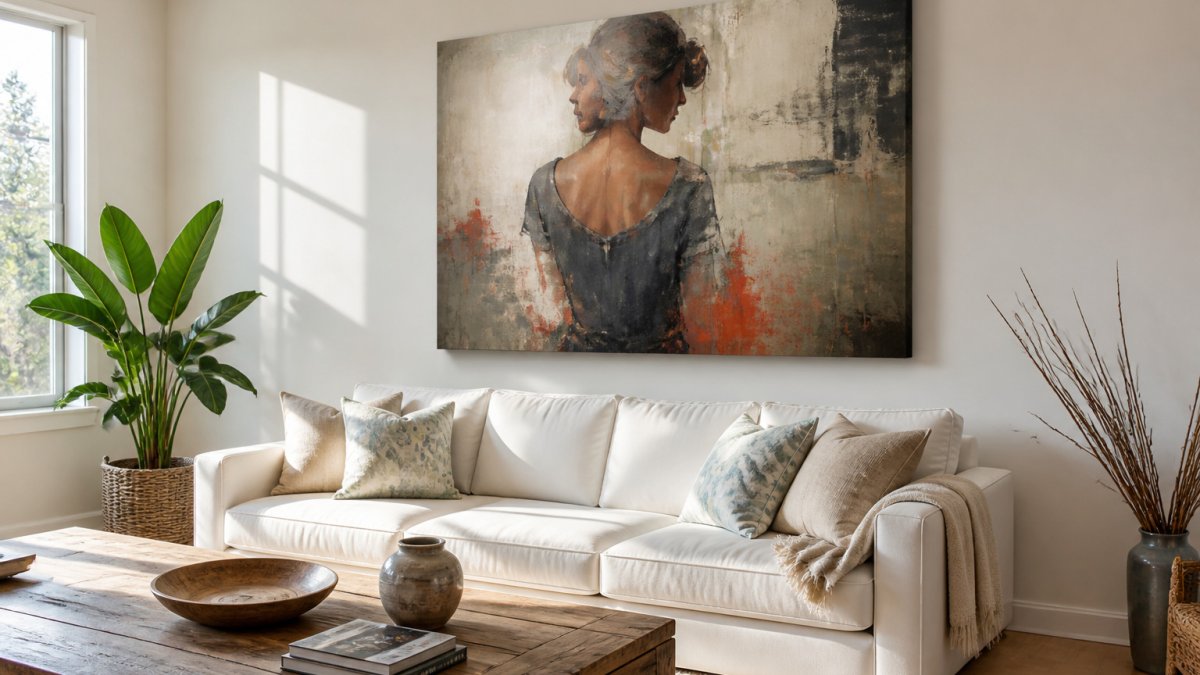
Viewing distance matters too. A large piece looks best when you can step back far enough to see the whole image. As a rough guide, give a large canvas several feet of space in front of it.
Here is a simple way to preview your size:
- Cut a piece of paper or cardboard to the exact dimensions.
- Tape it to the wall at the height you plan to hang the art.
- Live with it for a day or two, noticing it at different times of day.
- Move it if it feels too high, low, or crowded.
Many buyers find this step prevents costly mistakes.
Planning Your Canvas Prints on Wall for a Finished Look
When you plan several canvas prints on one wall, spacing matters. A common approach is to keep 2 to 4 inches between frames in a grouping, and to align the group's center with your eye-level line.
Mix sizes for interest, but keep one piece as the focal point. Our Custom Portrait with Sunglasses is available as a custom commission. Pieces that share a color or theme tie the group together.

Our Custom Portrait with Sunglasses is available as a custom commission.
Next Steps: Hanging a Large Portrait Painting With Confidence
Once you have chosen a size, the final step is hanging it securely. You can browse the large-format artwork collection to find a piece for your wall. Large portrait paintings can be heavier than they look, so choose wall hardware suited to the weight.
Our original Kiss Me by Annette Back at 24 x 36 inches and Heal by Annette Back at 48 x 30 inches are available as original oil paintings.
Frequently Asked Questions
What size canvas print should I buy for a sofa wall?
A canvas that covers about 60 to 75 percent of the sofa's width usually looks balanced. For a standard 84-inch sofa, that means roughly 50 to 63 inches wide.
How high should I hang canvas prints?
Hang the center of the artwork around 57 to 60 inches from the floor. This keeps the piece near eye level for most adults.
What resolution do I need for a large canvas print?
Print professionals commonly aim for about 300 DPI at the final printed size. Ask the printer or artist what file size they require before ordering.
Should I choose portrait or landscape orientation?
Choose portrait for narrow or tall spaces and landscape for wide walls above furniture. The shape of the room usually decides it.
Frequently Asked Questions
What is the best size for a canvas print?
There is no single best size. The right canvas print size depends on the wall it will hang on and the furniture beneath it. A common guideline is to make the print about 60 to 75 percent of the width of the sofa or console below it, which keeps the artwork from looking lost or overwhelming. Measure your wall first, then choose a size that leaves visible breathing room on both sides.
How do I measure a wall for a canvas print?
Measure the width of the wall from corner to corner, or from the edge of one piece of furniture to the other, and note the height from the floor to the ceiling. Mark the center point and the target eye level, which is usually around 57 to 60 inches from the floor to the center of the artwork. Use painter's tape to outline the candidate size on the wall before you commit. This method lets you see the proportion in your actual room rather than relying on a chart alone.
How do I choose a canvas size for a portrait?
Portrait-oriented canvases, taller than they are wide, suit vertical figures and tall spaces such as hallways or the wall beside a doorway. For a large portrait painting, consider the height of the wall and the viewing distance, since a figure seen from across a room needs enough scale to read clearly. Because each Annette Back custom portrait can be made in any size, you can discuss proportions directly with the artist before you order.


0 comments