


Last Updated: October 30, 2026
Quick Summary
To arrange art above a sofa, hang the bottom edge 6 to 10 inches above the sofa back and size the piece to span about two-thirds of the sofa's width. Center the art on the sofa's center line, not the wall, whenever the sofa sits off-center.
- Measure the sofa's width, backrest height, and distance from the wall before hanging anything.
- For an 84-inch sofa, aim for art around 50 to 56 inches wide.
- Keep 2 to 3 inches between frames in a gallery wall, or up to 4 inches for large pieces.
- Leave at least 6 inches of breathing room below the ceiling.
- Use two anchored points for heavy art; a single nail in drywall will fail.
Table of Contents
- Start With the Sofa, Not the Wall
- How High to Hang Art Above a Sofa
- Finding the Right Art Size Above a Sofa
- How to Center Art Above a Sofa (and When Not To)
- Building a Gallery Wall Above a Sofa
- Layout Templates for One Piece, a Row, or a Grid
- Hanging Hardware and Planning Before You Drill
- Choosing a Piece That Fits Your Room and Your Sofa
- Frequently Asked Questions
Start With the Sofa, Not the Wall
Most people hang art too high. That single mistake makes a living room feel off, and it happens because people measure from the ceiling instead of the sofa. The sofa sets the rules. Its width, height, and position decide how you arrange art.
Here is what that means in practice:
- Measure your sofa's total width, arm to arm.
- Note the height of the backrest from the floor.
- Check how far the sofa sits from the wall.
- Mark the wall's center line, then the sofa's center line.
Those four numbers answer almost every question in this guide. Get them right and the rest is arithmetic. Skip them and you will be patching holes.
How High to Hang Art Above a Sofa
The bottom edge of the art should sit 6 to 10 inches above the back of the sofa. That gap connects the two pieces visually. Closer than 6 inches feels cramped. Farther than 10 inches leaves the art floating alone.
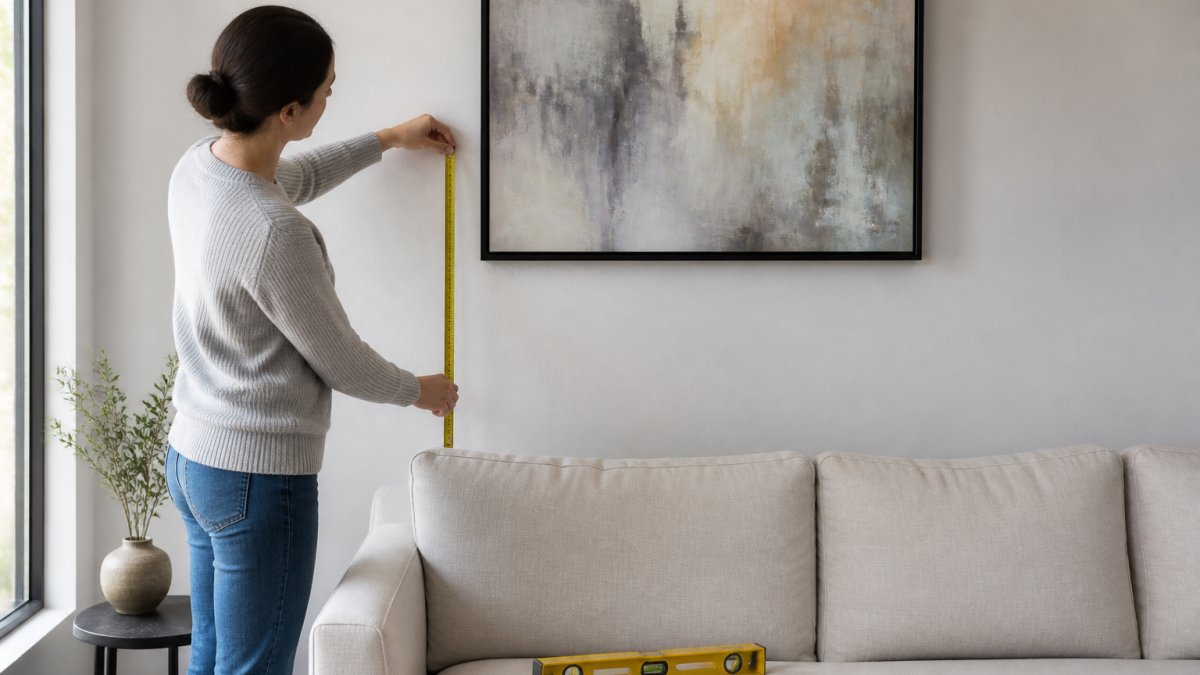
Work in this order:
- Measure from the floor to the top of the sofa back.
- Add 6 to 10 inches. This is your target for the bottom edge.
- Measure the art's height, including the frame.
- Add that to the target to find where the hanging hardware goes.
A common mistake is centering the art at eye level, around 57 to 60 inches. That rule works on empty walls. Above furniture, the sofa wins.
The key measurements for hanging art above a sofa, at a glance.
| Item | Value | Note |
|---|---|---|
| Gap above sofa back | 6 to 10 inches | Bottom edge of art to top of sofa back |
| Closer than 6 inches | Feels cramped | Too tight a gap |
| Farther than 10 inches | Art floats alone | Too large a gap |
| Eye-level rule | 57 to 60 inches | Works on empty walls, not above furniture |
Finding the Right Art Size Above a Sofa
Art should span about two-thirds of the sofa's width. This is the two-thirds rule, and it keeps a piece from looking lost or overpowering.
For a standard 84-inch sofa, aim for art around 50 to 56 inches wide. A single large canvas works best here. Wide, horizontal formats suit this spot because they echo the sofa's shape. A horizontal original such as Infinity by Annette Back - 48x24 gives you a broad horizontal presence without towering over the room.

Small pieces need company. One 16x20 canvas above a full-size sofa looks like a postage stamp. Group several smaller works instead, and treat the whole group as one shape.
How to Center Art Above a Sofa (and When Not To)
Center the art on the sofa, not on the wall, whenever the sofa sits off-center. This is the rule most guides skip. If your sofa is pushed to one side, wall-centering pulls the art away from the seating and the room feels broken.
Follow the sofa. Here is the sequence:
- Find the sofa's center point.
- Draw a light vertical line up from it.
- Center the art on that line.
When does wall-centering win? Only when the sofa is centered on that wall and nothing else competes for the space. In that case both lines land in the same spot, so the question answers itself.
Building a Gallery Wall Above a Sofa
A gallery wall above a sofa works when the arrangement stays inside the sofa's width and reads as one shape. Keep the outer edges of the group within the two-thirds zone. Anything wider spills past the seating and looks unmoored.
Start with the largest piece and place it slightly off-center. Build outward with smaller works, keeping 2 to 3 inches between frames. Cut paper templates and tape them to the wall first. This step saves your walls and your patience.
Mix sizes and orientations, but repeat one thing: frame color or subject matter. That repetition holds a busy wall together. If your room is tight, our guide on how to style art in small apartments covers the tighter spacing those spaces need.
Infinity by Annette Back - 48x24 →
Plan the whole wall on paper first
Before you make a single hole, build a full-size mock-up. This is the step most guides skip, and it is the one that prevents the most regret.
- Measure the sofa's width and mark the two-thirds zone on the wall with painter's tape.
- Cut paper templates for every frame, including the frame width, not just the canvas.
- Tape the templates to the wall and step back to the sofa. Sit down. Look at it from where you actually sit.
- Adjust until the group feels balanced left to right and top to bottom.
- Mark the hanging points on the templates, then transfer those marks to the wall.
A common pattern is to leave the templates up for a day. Morning light and evening light show different problems, and a day of looking catches what five minutes misses.
Spacing rules that hold up
- Between frames: 2 to 3 inches for a tight, unified group. Up to 4 inches if the pieces are large and the wall is wide.
- Above the sofa: the bottom edge of the lowest frame sits 6 to 10 inches above the sofa back.
- Below the ceiling: leave at least 6 inches of breathing room, and more if the ceiling is low.
- Left and right: keep the outer edges inside the two-thirds zone so the group stays tied to the sofa.
Three tested layouts
The anchor and satellites. One large piece centered on the sofa line, with two or three smaller works grouped around one corner. Keep the overall shape balanced left to right even though the pieces are not symmetrical. This suits a collection with one clear favorite.
The even grid. Four to six same-size pieces in two rows. Align outer edges into a clean rectangle and keep gaps even in both directions. A grid reads as calm and architectural, which suits a modern sofa and a plain wall.
The staggered salon wall. Anchor with one large piece, then fill around it with mixed sizes. Keep the total mass balanced left to right and avoid letting one corner carry all the visual weight.
When a gallery wall is the wrong choice
A gallery wall is not always the answer. If the wall is short, if the sofa sits close to a doorway, or if the room already has a lot of pattern, a single large piece will read better and cost less to hang. One strong horizontal canvas often does more for a room than six small frames competing for attention.
Layout Templates for One Piece, a Row, or a Grid
Pick a template based on how many pieces you own. Each one keeps the group proportionate to the couch.
- One statement piece: Center it on the sofa, bottom edge 6 to 10 inches up. Best for wide horizontal works like In Dreams by Annette Back - 40x16 or The Wave by Annette Back- 44x16.
- A row of three: Use three equal pieces with 2 to 3 inches between them. Center the middle piece on the sofa line.
- A grid of four to six: Align outer edges into a clean rectangle. Keep gaps even in both directions.
- A staggered salon wall: Anchor with one large piece, then fill around it. Keep the overall shape balanced left to right.
Sketch how you will arrange art on paper before you touch a hammer. It takes five minutes and prevents most regret.


Hanging Hardware and Planning Before You Drill
Match the hardware to your wall and the weight of the piece. This is where good plans fail.
- Drywall with wood studs: Drive screws into studs for anything heavy. Use a stud finder and mark both edges.
- Drywall without studs: Use self-drilling toggle anchors rated well above the art's weight.
- Plaster or brick: Use masonry anchors, and drill slowly to avoid cracking.
- Gallery walls: Consider a French cleat system so pieces can shift without new holes.
Watch out: a single nail in drywall will fail under a large framed canvas. The art drops, the frame breaks, and the wall needs repair. Two anchored points, always.
Plan the whole wall on paper first. Mark every hole, check the level twice, then drill once.
Choosing a Piece That Fits Your Room and Your Sofa
Scale decides more than style. A 48x30 canvas, for instance, matches a standard sofa's width and fills the wall without crowding it. Heal by Annette Back - 48x30 is an available original in that size.
Color matters too. A neutral sofa gives you room for bold, colorful work. A patterned or dark sofa calls for calmer pieces or a strong frame to separate art from fabric.
Large originals need wall space you may have to plan for. Measure first, then shop. Virtual live viewing and consultation services are available, and original pieces are shipped with secure, careful packing.
Frequently Asked Questions
How high should art hang above a sofa?
The bottom edge of the frame should sit 6 to 10 inches above the top of the sofa back. Closer to 6 inches keeps the art visually connected to the furniture; closer to 10 inches works when your sofa back is low or the ceiling is high. If you have a very tall sofa back or a low ceiling, anchor the art to eye level (about 57 to 60 inches from the floor to the center of the piece) and let the gap adjust. Measure from the sofa, not the floor, so the art reads as part of the seating group.
How wide should artwork be above a sofa?
Aim for the art to span roughly two-thirds of the sofa's width. On a standard 84-inch sofa, that means a total arrangement about 56 inches wide. A single large piece, a horizontal row of three, or a gallery cluster can all hit that target. If your art size above sofa falls short, widen the arrangement with additional pieces or wider spacing rather than hanging one small frame floating over a long couch. Too-small art over a large sofa is the most common proportion mistake.
Should art be centered over the sofa or centered on the wall?
Center the art on the sofa, not the wall, in most living rooms. The sofa is the visual anchor, and centering on it keeps the arrangement balanced even when the couch sits off-center in the room. Center on the wall only when the sofa is centered on that wall too, or when the art is a single large statement piece meant to read as architecture. If a doorway or window crowds one side, shift the art to stay centered on the sofa and let the asymmetry live in the room, not in the arrangement.
Can you hang one large piece above a sofa, or do you need multiple frames?
One large piece works beautifully and is often the cleanest choice. A single horizontal canvas, such as a 48-inch-wide original, fills the two-thirds span on a standard sofa and gives the room a focal point without visual clutter. Choose a single piece when your sofa is the only strong element on the wall; choose a row or gallery when you want to layer in color and narrative. Either way, keep the total width proportionate to the couch and the bottom edge 6 to 10 inches above the sofa back.
The gap between a room that feels finished and one that feels almost there is usually a few inches of placement. Measure your sofa, mark the line, and hang with confidence. Explore the originals at Annette Back Fine Art, where each piece is signed, dated, and shipped with care, and let us help you find the work that anchors your living room.


0 comments